Skip to main content
General Biology
Il mio corso
Impara
Preparazione agli esami
AI Tutor
Guide di studio
Soluzioni per libri di testo
Flashcard
Esplora
Prova l'app
Il mio corso
Impara
Preparazione agli esami
AI Tutor
Guide di studio
Soluzioni per libri di testo
Flashcard
Esplora
Prova l'app
Indietro
General Biology: Protein Structure and Function
Puoi toccare per girare la carta.
What is a polypeptide?
Puoi toccare per girare la carta.
👆
What is a polypeptide?
A polypeptide
is a polymer made up of amino acids linked by peptide bonds.
Avanzamenti del tracciato
I pulsanti di controllo sono stati cambiati in modalità "navigazione".
1/20
Video consigliati
08:02
Protein Structure
24557
views
332
rank
04:37
Amino Acids
25241
views
448
rank
02:50
Proteins
30746
views
589
rank
1
comments
Termini in questo insieme (20)
Nascondere definizioni
What is a polypeptide?
A polypeptide
is a polymer made up of amino acids linked by peptide bonds.
What is the primary structure of a protein?
The
primary structure
is the linear sequence of amino acids in a polypeptide chain.
What type of bond links amino acid residues in a polypeptide?
A
peptide bond
connects the carbon atom of one amino acid to the nitrogen atom of the next.
Name the two most common forms of secondary protein structure.
The two most common secondary structures are the
alpha helix
and the
beta sheet
.
What forces stabilize secondary protein structures?
Hydrogen bonds
between backbone atoms stabilize alpha helices and beta sheets.
What is the tertiary structure of a protein?
The
tertiary structure
is the overall 3D arrangement of a polypeptide, including secondary structures and side chain orientations.
List the main forces contributing to protein tertiary structure.
Tertiary structure is stabilized by
hydrogen bonds
,
ionic bonds
,
van der Waals forces
,
disulfide bonds
, and the
hydrophobic effect
.
What is the quaternary structure of a protein?
The
quaternary structure
is the arrangement of multiple polypeptide subunits into a functional protein complex.
What is the role of hydrogen bonds in protein folding?
Hydrogen bonds
help stabilize secondary and tertiary structures by linking backbone and side chain atoms.
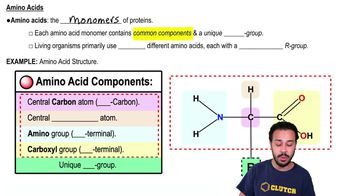
Define an amino acid.
An
amino acid
is an organic molecule with an amino group, a carboxyl group, a hydrogen atom, and a variable side chain attached to a central carbon.
How are amino acids classified by side chain polarity?
Amino acids can be
polar noncharged
,
charged
, or
nonpolar
based on their side chain properties.
What is a molecular mimic in biology?
A
molecular mimic
is a molecule that resembles another molecule structurally or functionally.
Describe one chemical method to denature a polypeptide.
Denaturation can be caused by chemicals like
urea
or
detergents
that disrupt hydrogen bonds and hydrophobic interactions.
What is the significance of weak chemical bonds like hydrogen bonds in biology?
Weak bonds like
hydrogen bonds
are crucial for maintaining protein structure and facilitating molecular interactions.
What is the hydrophobic effect in protein folding?
The
hydrophobic effect
drives nonpolar side chains to the protein interior, stabilizing tertiary structure.
What is the difference between polar and nonpolar amino acid side chains?
Polar side chains
can form hydrogen bonds, while
nonpolar side chains
are hydrophobic and avoid water.
What is the role of disulfide bonds in proteins?
Disulfide bonds
are covalent links between cysteine residues that stabilize tertiary and quaternary structures.
What is the function of hemoglobin's quaternary structure?
Hemoglobin's
quaternary structure
allows cooperative oxygen binding by multiple subunits.
What is an orbital in the context of chemistry?
An
orbital
is a region around an atom's nucleus where electrons are most likely found.
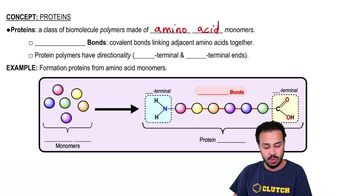
What is a peptide bond?
A
peptide bond
is a covalent bond formed between the carboxyl group of one amino acid and the amino group of another.
 IndietroIndietro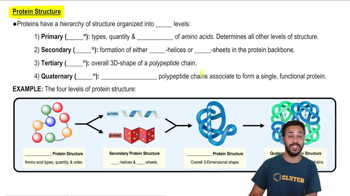
 08:02
08:02