 Indietro
General Biology: Scientific Method and Measurements
 01:35
01:35
Termini in questo insieme (20)
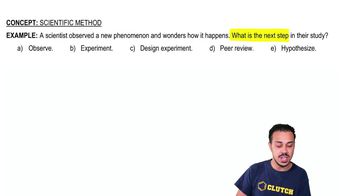
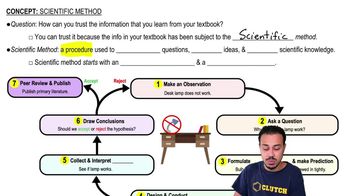
Observation: An initial observation is made about a phenomenon in the natural world.
A hypothesis must be testable and potentially falsifiable to be investigated scientifically.
Independent variable: changed by the investigator.
Dependent variable: measured response affected by the independent variable.
A control treatment sets the independent variable at a standard value or eliminates it to compare against the experimental treatment.
Replication increases confidence that results are due to the independent variable and accounts for natural variability.
Qualitative data: descriptive qualities like color or smell.
Quantitative data: measurable values like weight or length.
The basic unit of length is the meter (m).
1 kilometer (km) = \(10^{3}\) meters (m).
The meniscus is the curved surface of a liquid in a container; measure volume at the lowest point of the meniscus at eye level.
The basic unit of volume is the liter (L).
Freezing point of water: 0 °C and 32 °F.
\(\degree F = (\degree C \times \frac{9}{5}) + 32\)
The basic unit of mass is the gram (g).
Taring sets the balance to zero with a container on it, so only the mass of the sample is measured.
A % (weight/volume) solution is made by dissolving grams of solute in enough solvent to make 100 mL total volume.
Add all values and divide by the number of values.
Order the data and find the middle value; if even number of values, average the two middle numbers.
It means the hypothesis can be disproven by evidence, allowing scientific testing.
Standardized variables are kept constant to ensure changes in the dependent variable are due only to the independent variable.
Boiling point of water: 100 °C and 212 °F.