 Indietro
General Biology: Structure and Function of Large Biological Molecules
 04:19
04:19
Termini in questo insieme (20)
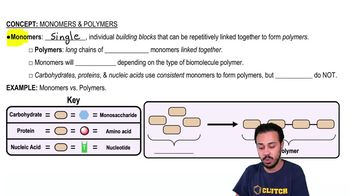
A polymer is a long molecule made of many similar or identical building blocks called monomers. Carbohydrates, proteins, and nucleic acids are biological polymers.
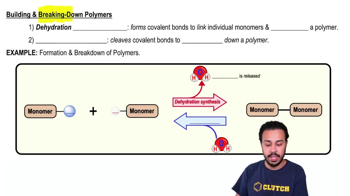
Dehydration reactions build polymers by removing water to form bonds; hydrolysis breaks polymers by adding water to break bonds.
A limited set of monomers can be arranged in countless ways to form diverse polymers, similar to how 26 letters create infinite words.
Carbohydrates have a formula roughly \((CH_2O)_n\), with a carbon:hydrogen:oxygen ratio of about 1:2:1.
Monosaccharides are simple sugars like glucose that serve as major fuel and raw materials for building larger carbohydrates.
A glycosidic linkage is a covalent bond formed between two monosaccharides during dehydration synthesis to create disaccharides or polysaccharides.
Plants store glucose as starch (helical polymer), animals store it as glycogen (extensively branched polymer) for energy reserves.
Cellulose has β-glycosidic linkages forming rigid microfibrils; most animal enzymes cannot hydrolyze these β bonds, so cellulose passes as fiber.
Starch has α-1,4 glycosidic linkages causing a helical shape; cellulose has β-1,4 linkages forming straight, rigid chains.
Chitin is a structural polysaccharide with nitrogen-containing groups, forming the exoskeleton of arthropods and fungal cell walls.
Branching in glycogen allows rapid release of glucose during high energy demand due to many accessible chain ends.
Phospholipids have hydrophilic (polar) heads and hydrophobic (nonpolar) tails, driving spontaneous bilayer formation in water.
Saturated fatty acids have no double bonds, straight chains, pack tightly, solid at room temp; unsaturated have cis double bonds causing kinks, preventing tight packing, liquid at room temp.
Triacylglycerols store concentrated long-term energy by linking three fatty acids to glycerol via ester linkages.
Steroids have a rigid carbon skeleton of four fused rings; cholesterol regulates membrane fluidity and is a precursor for hormones.
LDL transports cholesterol to tissues and can cause plaque buildup (bad); HDL removes excess cholesterol for excretion (good).
The primary structure is the linear sequence of amino acids dictated by genetic information.
Secondary structure includes α-helices and β-pleated sheets formed by hydrogen bonds along the polypeptide backbone.
Tertiary structure is stabilized by interactions between R groups: hydrophobic interactions, ionic bonds, hydrogen bonds, and disulfide bridges.
Quaternary structure arises when multiple polypeptide subunits assemble into a functional protein complex.