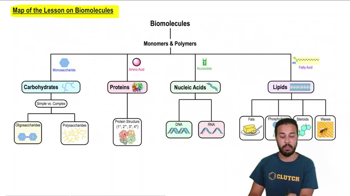
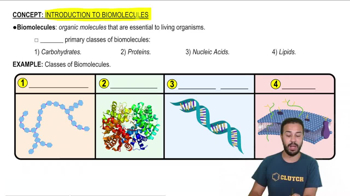
Macromolecules are large polymers made of many similar building blocks called monomers. Examples include carbohydrates, proteins, and nucleic acids.
What is the role of enzymes in polymer synthesis and breakdown?
Enzymes speed up chemical reactions that make or break down polymers. Dehydration reactions join monomers by removing water, while hydrolysis breaks polymers by adding water.
What are carbohydrates and their basic units?
Carbohydrates include sugars and polymers of sugars. The simplest carbohydrates are monosaccharides, such as glucose, which serve as fuel and building material.
How are monosaccharides classified?
Monosaccharides are classified by the location of the carbonyl group (aldose or ketose) and the number of carbons in the skeleton (e.g., triose, pentose, hexose).
What is a glycosidic linkage?
A glycosidic linkage is a covalent bond formed between two monosaccharides during a dehydration reaction to form a disaccharide.
What determines the structure and function of polysaccharides?
The sugar monomers and the positions of glycosidic linkages determine a polysaccharide's architecture and function, such as storage or structural roles.
What is starch and its structure?
Starch is a plant storage polysaccharide made of glucose monomers, mainly in the form of amylose, which is unbranched and helical.
What is glycogen and where is it stored?
Glycogen is an animal storage polysaccharide stored mainly in liver and muscle cells, used to release glucose when needed.
How does cellulose differ from starch?
Cellulose is a structural polysaccharide with β-glucose monomers forming straight, unbranched chains with hydrogen bonds, unlike the α-glucose helical starch.
Why can't humans digest cellulose?
Humans lack enzymes to hydrolyze β-glycosidic linkages in cellulose, so it passes as insoluble fiber, though some microbes can digest it.
What is chitin and its biological role?
Chitin is a structural polysaccharide found in arthropod exoskeletons and fungal cell walls, providing support and protection.
What are lipids and their common feature?
Lipids are hydrophobic molecules that do not form true polymers, mainly composed of hydrocarbon regions, including fats, phospholipids, and steroids.
What are fats made of?
Fats are made from glycerol and three fatty acids joined by ester linkages, forming triacylglycerols or triglycerides.
Difference between saturated and unsaturated fatty acids?
Saturated fatty acids have no double bonds and maximum hydrogens, making fats solid at room temperature; unsaturated fatty acids have one or more double bonds, causing kinks and liquid oils.
What is hydrogenation and its health impact?
Hydrogenation converts unsaturated fats to saturated fats by adding hydrogen, sometimes creating trans fats, which may increase cardiovascular disease risk.
What is the main function of fats in organisms?
Fats primarily function in long-term energy storage, cushioning organs, and insulating the body.
Describe the structure of phospholipids.
Phospholipids have two hydrophobic fatty acid tails and a hydrophilic phosphate-containing head, allowing them to form bilayers in water.
What is the biological significance of the phospholipid bilayer?
The bilayer forms the plasma membrane, creating a selective barrier between the cell and its environment with hydrophobic tails inward and hydrophilic heads outward.
What are steroids and their role?
Steroids have a carbon skeleton of four fused rings; cholesterol is a key steroid in animal membranes and a precursor for other steroids.
What are proteins and their general functions?
Proteins are polymers of amino acids with diverse functions including catalysis, defense, transport, communication, movement, and structural support.
What determines a protein's function?
A protein's function depends on its unique three-dimensional structure, which is determined by its amino acid sequence.
What are the four levels of protein structure?
Primary: amino acid sequence; Secondary: α helices and β sheets from hydrogen bonds; Tertiary: 3D folding from side chain interactions; Quaternary: multiple polypeptide chains.
What causes sickle-cell disease at the molecular level?
A single amino acid substitution in hemoglobin's primary structure causes abnormal folding, leading to sickle-shaped red blood cells.
What is protein denaturation?
Denaturation is the loss of a protein's native structure due to environmental changes like pH or temperature, resulting in loss of function.
What are nucleic acids and their monomers?
Nucleic acids (DNA and RNA) are polymers of nucleotides, each consisting of a nitrogenous base, a pentose sugar, and phosphate groups.
What is the difference between DNA and RNA nucleotides?
DNA contains deoxyribose sugar and thymine; RNA contains ribose sugar and uracil instead of thymine.
How are nucleotides linked in nucleic acids?
Nucleotides are linked by phosphodiester bonds between the sugar of one nucleotide and the phosphate of the next, forming a sugar-phosphate backbone.
What is complementary base pairing in DNA?
Adenine pairs with thymine, and guanine pairs with cytosine via hydrogen bonds, enabling DNA replication and stability.
What is the central dogma of molecular biology?
Genetic information flows from DNA to RNA to protein, where DNA directs RNA synthesis, which in turn directs protein synthesis.
 Indietro
 01:17