 Indietro
General Biology: Structure and Function of Large Biological Molecules
 01:17
01:17
Termini in questo insieme (36)
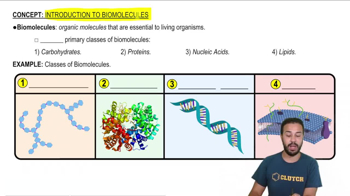
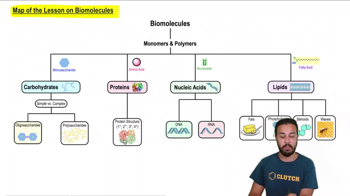
Carbohydrates, lipids, proteins, and nucleic acids.
Monomers are building blocks; polymers are long molecules made of repeating monomers.
Dehydration removes water to join monomers; hydrolysis adds water to break polymers.
Simple sugar = monosaccharide; sugar polymer = polysaccharide.
Glucose is the most common monosaccharide.
3 C = trioses; 5 C = pentoses; 6 C = hexoses.
Glucose mainly exists in a ring form in water.
A glycosidic linkage connects two monosaccharides.
Energy storage and structure.
Plants store glucose as starch; animals store glucose as glycogen.
Starch has α-glucose linkages; cellulose has β-glucose linkages.
Humans lack enzymes to break β linkages in cellulose.
Chitin is found in arthropod exoskeletons and fungal cell walls.
Lipids contain large hydrocarbon regions that do not mix well with water.
One glycerol + three fatty acids form a triglyceride.
An ester linkage is formed by dehydration reactions.
Saturated fats have no C=C double bonds; unsaturated fats have one or more C=C bonds.
Long-term energy storage, cushioning, and insulation.
Phospholipids have a hydrophilic head and two hydrophobic tails.
Phospholipids form a bilayer with heads facing water and tails inward.
Steroids have four fused carbon rings.
Enzymes are proteins that act as catalysts.
Proteins are constructed from 20 different amino acids.
The R group (side chain) varies among amino acids.
Peptide bonds join amino acids via dehydration reactions.
Primary (sequence), secondary (α helix & β sheet), tertiary (3D shape), quaternary (multiple polypeptides).
Protein shape determines its function.
A change in protein primary structure causes sickle-cell disease.
Denaturation causes loss of protein function.
Nucleotides are the monomers of nucleic acids.
DNA → RNA → Protein.
Nucleotide = base + sugar + phosphate group(s).
Purines = adenine & guanine; DNA sugar = deoxyribose.
Phosphodiester linkages connect nucleotides in nucleic acids.
A pairs with T; G pairs with C.
DNA is generally double-stranded; RNA is generally single-stranded.