 Indietro
General Biology: Structure and Function of Large Biological Molecules
 04:19
04:19
Termini in questo insieme (20)
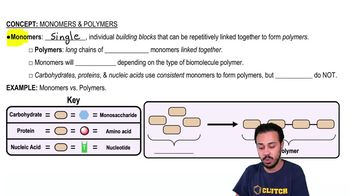
A polymer is a long molecule consisting of many similar building blocks called monomers.
A monomer is a repeating unit that serves as a building block of a polymer.
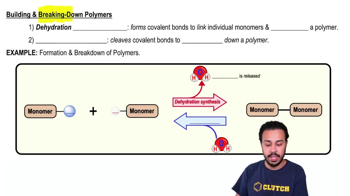
A dehydration reaction joins two monomers by removing a water molecule, forming a new covalent bond.
Hydrolysis breaks down polymers into monomers by adding a water molecule, breaking the covalent bond.
Carbohydrates are polymers made of sugar monomers called monosaccharides.
Common monosaccharides include glucose, fructose, and galactose.
Polysaccharides function in energy storage (starch, glycogen) and structural support (cellulose, chitin).
Starch has α-1,4 glycosidic linkages and is branched; cellulose has β-1,4 linkages and is unbranched, forming microfibrils.
Lipids are hydrophobic molecules including fats, phospholipids, and steroids, not true polymers.
Fats are made of glycerol and three fatty acids joined by ester linkages.
Saturated fats have no double bonds; unsaturated fats have one or more double bonds causing kinks.
Phospholipids form cellular membranes with hydrophilic heads and hydrophobic tails.
Cholesterol is a steroid that stabilizes membrane fluidity in animal cells.
Proteins are polymers of amino acids linked by peptide bonds.
Proteins function as enzymes, transporters, receptors, structural components, and in movement.
Primary: amino acid sequence; Secondary: α-helices and β-sheets; Tertiary: 3D folding; Quaternary: multiple polypeptides.
A single amino acid substitution in hemoglobin's primary structure causes sickle-cell disease.
Denaturation is the loss of protein structure and function due to environmental changes.
Nucleic acids are polymers of nucleotides that store and transmit hereditary information.
DNA contains nucleotides with bases A, T, C, G; RNA contains A, U, C, G.