 Indietro
General Biology Study Guide Flashcards
 07:48
07:48
Termini in questo insieme (30)
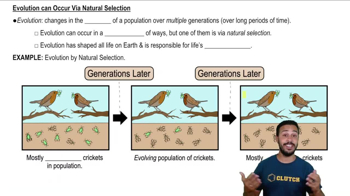
Descent with modification; the process by which species accumulate differences from their ancestors as they adapt to different environments over time; also defined as a change in the genetic composition of a population from generation to generation.
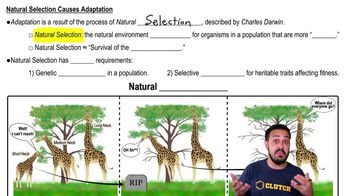
A process in which individuals with certain inherited traits tend to survive and reproduce at higher rates than others because of those traits.
Process in which humans select and breed individuals that have desired traits.
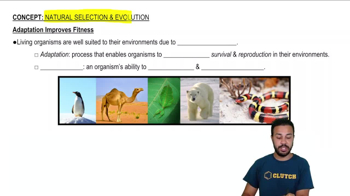
Inherited characteristic of an organism that enhances its survival and reproduction in a specific environment.
Similarity in characteristics resulting from a shared ancestry.
Structures in different species that are similar because of common ancestry; may or may not have similar functions.
The evolution of similar features in independent evolutionary lineages.
Characteristics that are similar because of convergent evolution, not homology.
The study of geographic distribution of species.
The evolutionary history of a species or group of related species.
A branching diagram representing a hypothesis about the evolutionary history of a group of organisms.
Point on a phylogenetic tree where a lineage splits into two or more taxa from a common ancestor.
Groups of organisms that share an immediate common ancestor and are each other's closest relatives.
A group consisting of a common ancestor and all of its descendants; equivalent to a clade.
A group consisting of a common ancestor and some, but not all, of its descendants.
A group including distantly related organisms but not their most recent common ancestor.
The principle that the simplest explanation consistent with the facts should be investigated first.
A method estimating the time required for evolutionary change based on constant rates of genome evolution.
The transfer of genes between genomes through mechanisms like plasmid exchange, viral activity, or fusion of organisms.
Evolutionary change below the species level; change in allele frequencies in a population over generations.
Random fluctuations in allele frequencies due to chance events, especially in small populations.
Genetic drift when a few individuals become isolated and form a new population with a gene pool not reflective of the original.
Genetic drift when a population size is drastically reduced, causing survivors to be genetically unrepresentative of the original population.
The transfer of alleles from one population to another through movement of fertile individuals or gametes.
The contribution an individual makes to the gene pool of the next generation relative to others in the population.
Natural selection favoring individuals at one end of the phenotypic range.
Natural selection favoring individuals at both extremes of a phenotypic range over intermediate phenotypes.
Natural selection maintaining two or more phenotypic forms in a population.
Greater reproductive success of heterozygous individuals compared with homozygotes, preserving genetic variation.
State where allele and genotype frequencies remain constant from generation to generation if no evolutionary forces act.