Skip to main content
General Biology
Il mio corso
Impara
Preparazione agli esami
AI Tutor
Guide di studio
Soluzioni per libri di testo
Flashcard
Esplora
Prova l'app
Il mio corso
Impara
Preparazione agli esami
AI Tutor
Guide di studio
Soluzioni per libri di testo
Flashcard
Esplora
Prova l'app
Indietro
General Biology Test 2 Key Concepts
Puoi toccare per girare la carta.
Range of object sizes visible with a light microscope
Puoi toccare per girare la carta.
👆
Range of object sizes visible with a light microscope
Light microscopes
can visualize structures down to about \(200\,\text{nm}\), suitable for eukaryotic cells and many organelles.
Avanzamenti del tracciato
I pulsanti di controllo sono stati cambiati in modalità "navigazione".
1/30
Video consigliati
03:21
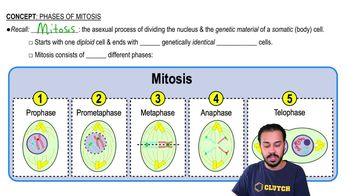
Phases of Mitosis
26495
views
469
rank
01:58
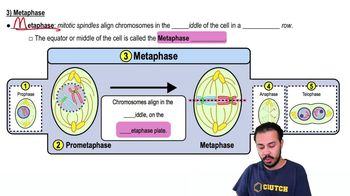
Metaphase
17963
views
245
rank
03:20
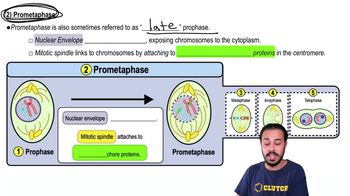
Prometaphase
18090
views
293
rank
Termini in questo insieme (30)
Nascondere definizioni
Range of object sizes visible with a light microscope
Light microscopes
can visualize structures down to about \(200\,\text{nm}\), suitable for eukaryotic cells and many organelles.
Difference between SEM and TEM
SEM
detects electrons bouncing off surfaces;
TEM
detects electrons passing through specimen interiors.
Purpose of stains in light microscopy
Stains increase
contrast
to make transparent or colorless cellular structures visible.
Cell fractionation function
Allows study of macromolecules and organelles, which may remain biologically active.
Structures present in bacterial cells
Bacteria lack membrane-bound organelles; have plasma membrane, cell wall, capsule, nucleoid with circular chromosome, and ribosomes.
Limit to cell growth
Surface area to volume ratio (
SA/V
) limits cell size and growth.
Organelles shared by plant and animal cells
Nucleus, mitochondria, ER, Golgi apparatus, ribosomes, plasma membrane, peroxisomes, cytoplasm/cytoskeleton, and vacuoles.
Organelles unique to plant cells
Cell wall, chloroplasts, large central vacuole, and plastids.
Organelles unique to animal cells
Centrosomes with centrioles and lysosomes.
Function of nuclear envelope and nuclear pores
Double membrane enclosing nucleus; pores regulate molecule entry and exit.
Function of smooth and rough ER
Smooth ER produces lipids and detoxifies chemicals; rough ER synthesizes and folds proteins.
Role of Golgi apparatus
Modifies, sorts, packages proteins and lipids from ER, then ships them to destinations.
Lysosomes function
Membrane-bound organelles that digest and recycle cellular waste.
Phagocytosis definition
Cellular process engulfing and digesting large particles like bacteria or debris.
Function of central vacuole in plant cells
Stores water and maintains turgor pressure to keep plant cells rigid.
Composition of plasma membrane
Phospholipid bilayer with embedded proteins, cholesterol, and carbohydrates.
Endosymbiont theory
Mitochondria and chloroplasts originated from free-living prokaryotes engulfed by ancestral eukaryotic cells.
Cytoskeleton components and monomers
Microtubules (tubulin), microfilaments (actin), and intermediate filaments (various proteins).
Microtubules function
Provide structural support, intracellular transport tracks, and chromosome separation during cell division.
Motor proteins kinesin and dynein
Convert ATP energy into mechanical work to move cargo along microtubules.
Structural organization of cilia and flagella
Both have a 9+2 microtubule arrangement; cilia beat back and forth, flagella move in propeller-like motion.
Primary vs secondary plant cell wall
Primary is thin and flexible during growth; secondary is thick and rigid after growth.
Plasmodesmata function
Channels through plant cell walls allowing communication and transport between cells.
Types of animal cell junctions
Tight junctions (seal), anchoring junctions (support), and gap junctions (communication).
Fluid mosaic model of membrane structure
Membrane is a fluid bilayer of lipids with proteins moving laterally, essential for function.
Active vs passive transport
Active transport requires energy to move substances against gradients; passive transport does not.
Osmosis vs diffusion
Diffusion moves particles from high to low concentration; osmosis is diffusion of water across a semipermeable membrane.
Membrane potential
Voltage difference across a cell membrane due to ion distribution.
Sodium-potassium pump function
Uses ATP to move 3 Na+ out and 2 K+ into animal cells against concentration gradients.
Types of endocytosis
Phagocytosis (large particles), pinocytosis (fluids), receptor-mediated (specific molecules).
 IndietroIndietro
 03:21