 Indietro
General Biology: The Chemical Context of Life
 02:13
02:13
Termini in questo insieme (29)
Matter is anything that takes up space and has mass.
An element is a substance that cannot be broken down into other substances by chemical reactions.
A compound is a substance consisting of two or more elements combined in a fixed ratio.
Trace elements are required by an organism in only minute quantities, such as iron and iodine.
An atom is the smallest unit of matter that retains the properties of an element.
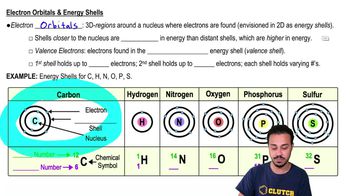
Proton (+), Neutron (neutral), Electron (-).
The atomic number is the number of protons in an atom's nucleus.
Isotopes are atoms of the same element with the same number of protons but different numbers of neutrons.
Potential energy is energy matter possesses due to its location or structure, such as electrons in energy levels.
Neon is inert because its outermost electron shell is full, making it unreactive.
A covalent bond is the sharing of a pair of valence electrons between two atoms.
Polar covalent bonds share electrons unequally; nonpolar covalent bonds share electrons equally.
An ionic bond forms when electrons are transferred from one atom to another, creating charged ions.
Cation is a positively charged ion; anion is a negatively charged ion.
A hydrogen bond is a weak attraction between a hydrogen atom and an electronegative atom like oxygen or nitrogen.
Molecular shape determines how biological molecules recognize and respond to each other with specificity.
Reactants are starting materials; products are the resulting materials after a chemical reaction.
Chemical equilibrium occurs when the rate of the forward reaction equals the rate of the reverse reaction, stabilizing concentrations.
Water is polar because of its V-shaped structure and unequal sharing of electrons, giving partial charges.
Cohesion, temperature moderation, expansion upon freezing, and versatility as a solvent.
Cohesion is the hydrogen bonding that holds water molecules together.
Transpiration is water movement up plants via cohesion and adhesion against gravity.
Specific heat is the amount of heat needed to raise the temperature of 1 g of a substance by 1°C.
Ice is less dense than liquid water because hydrogen bonds hold molecules farther apart in solid form.
A solvent dissolves a substance; a solute is dissolved; together they form a solution.
Hydrophilic molecules attract water; hydrophobic molecules repel water.
An acid increases the H+ concentration in a solution.
A base reduces the H+ concentration by accepting H+ or donating OH- ions.
Buffers accept H+ when in excess and donate H+ when depleted to stabilize pH.