 Indietro
General Biology: The Chemical Context of Life
 02:13
02:13
Termini in questo insieme (20)
Matter is anything that takes up space and has mass.
An element is a substance that cannot be broken down by chemical reactions. A compound consists of two or more elements in a fixed ratio with different properties from its elements.
Carbon, hydrogen, oxygen, and nitrogen make up 96% of living matter.
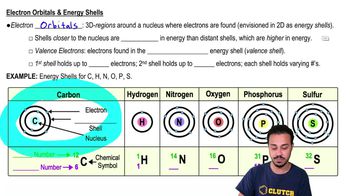
Atoms are composed of protons (positive charge), neutrons (no charge), and electrons (negative charge).
The atomic number is the number of protons in an atom's nucleus and equals the number of electrons in a neutral atom.
Atomic mass is approximately the sum of protons and neutrons in the nucleus (mass number).
Isotopes are atoms of the same element with different numbers of neutrons.
Electron potential energy depends on its distance from the nucleus; farther electrons have higher potential energy.
Electron shells are energy levels where electrons reside, with inner shells having lower energy than outer shells.
Valence electrons are electrons in the outermost shell that determine an atom's chemical behavior.
An orbital is a 3D space where an electron is likely found 90% of the time, with a maximum of 2 electrons per orbital.
A covalent bond is a chemical bond formed by sharing a pair of valence electrons between two atoms.
A single bond shares one pair of electrons; a double bond shares two pairs.
Electronegativity is an atom's attraction for electrons in a covalent bond.
Nonpolar bonds share electrons equally; polar bonds share electrons unequally due to differing electronegativities.
Ionic bonds form when atoms transfer electrons, creating oppositely charged ions that attract each other.
A cation is a positively charged ion; an anion is a negatively charged ion.
Hydrogen bonds are weak attractions between a hydrogen atom covalently bonded to an electronegative atom and another electronegative atom.
Van der Waals interactions are weak, temporary attractions between molecules due to uneven electron distribution.
A molecule's shape determines how it recognizes and responds to other molecules, influencing biological function.