 Indietro
General Biology: The Chemistry of Living Things
 02:13
02:13
Termini in questo insieme (28)
Matter is anything that takes up space and has mass, including organisms, rocks, and oceans.
An atom is the smallest unit of an element and matter, made of subatomic particles.
Protons (positive charge, in nucleus), neutrons (neutral, in nucleus), and electrons (negative charge, orbit nucleus).
The atomic number is the number of protons in the nucleus, unique to each element.
The mass number is the total number of protons and neutrons in an atom's nucleus.
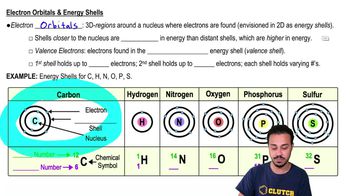
Electron shells are 3D regions around the nucleus where electrons are found, with shells closer to the nucleus having lower energy.
Atoms are more stable and less reactive when their outer valence shells are fully occupied, usually with 8 electrons.
Isotopes are atoms of the same element with the same number of protons but different numbers of neutrons.
Unstable isotopes that break down and emit energy as rays or particles; used in medicine and radiometric dating.
Chemical bonds are attractive forces between atoms that hold them together to form molecules and compounds.
Intramolecular bonds occur within a molecule; intermolecular bonds occur between different molecules.
Covalent bonds form when two atoms share one or more pairs of electrons.
Nonpolar covalent bonds share electrons equally; polar covalent bonds share electrons unequally due to different electronegativities.
Noncovalent bonds are interactions between atoms without sharing electrons, including ionic, hydrogen, and Van der Waals bonds.
Ions are atoms or molecules with a net electrical charge due to gain or loss of electrons; anions are negative, cations are positive.
An ionic bond is an electrical attraction between oppositely charged ions formed by transfer of electrons.
A hydrogen bond is a weak interaction between a hydrogen atom covalently bonded to an electronegative atom and another electronegative atom.
Water has polar covalent bonds with partial positive charges on hydrogen and partial negative on oxygen, making it polar.
Cohesion, adhesion, high specific heat, high heat of vaporization, density anomaly (ice floats), and universal solvent properties.
Cohesion is water molecules sticking to each other; adhesion is water molecules sticking to other polar substances.
Ice is less dense because stable hydrogen bonds form a lattice structure that spaces molecules farther apart than in liquid water.
Specific heat is the energy needed to raise temperature; water's high specific heat helps resist temperature changes, stabilizing environments.
Evaporation is liquid to gas phase change; heat of vaporization is energy required for this change, high in water due to hydrogen bonds.
Water dissolves many substances due to its polarity, forming hydration shells around solutes.
Hydrophilic substances dissolve in water due to affinity; hydrophobic substances do not dissolve and repel water.
Acids increase H+ concentration; bases decrease H+ concentration in aqueous solutions.
The pH scale measures H+ concentration, ranging from 0 (acidic) to 14 (basic), with 7 being neutral.
Buffers are substances that resist changes in pH by donating or accepting H+ ions to maintain stable pH.