Indietro

General Biology: The Molecules of Cells

I pulsanti di controllo sono stati cambiati in modalità "navigazione".
1/30
  • Why is lactose intolerance considered normal in adult humans?

    Most adults lack the enzyme lactase needed to digest lactose, making lactose intolerance the typical condition.
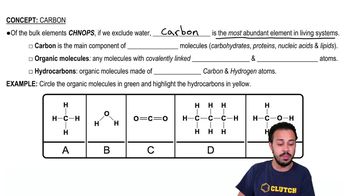
  • Why is carbon unparalleled in forming large, diverse molecules?

    Carbon can form four covalent bonds, allowing it to build complex, diverse organic compounds with various shapes.
  • Define organic compounds, hydrocarbons, carbon skeleton, and isomer.

    • Organic compounds: molecules with carbon atoms.
    • Hydrocarbons: compounds of only carbon and hydrogen.
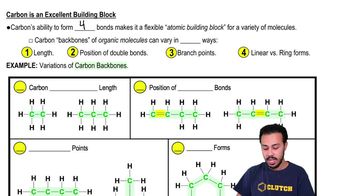
    • Carbon skeleton: chain of carbon atoms forming the molecule's backbone.
    • Isomers: molecules with the same formula but different structures.
  • What are the six important chemical groups in biological molecules?

    Hydroxyl, carbonyl, carboxyl, amino, phosphate, and methyl groups, each conferring specific chemical properties.
  • What are the four main classes of macromolecules important to life?

    Carbohydrates, lipids, proteins, and nucleic acids.
  • Explain the relationship between monomers and polymers.

    Monomers are small building blocks that join via dehydration synthesis to form polymers, large molecules.
  • Compare dehydration synthesis and hydrolysis.

    Dehydration synthesis links monomers by removing water; hydrolysis breaks polymers by adding water.
  • What is a monosaccharide?

    The simplest carbohydrate, a sugar monomer with formula multiples of CH2O, containing hydroxyl and carbonyl groups.
  • How are disaccharides formed?

    Two monosaccharides join by dehydration synthesis, forming a disaccharide and releasing water.
  • Why has the FDA proposed including grams of added sugars on food labels?

    Because high added sugar intake correlates with adverse health effects, limiting added sugars is recommended.
  • What are polysaccharides and their functions?

    Long chains of sugar units; starch and glycogen store energy, cellulose provides structural support, chitin forms exoskeletons.
  • What are lipids and their common characteristic?

    Hydrophobic molecules mainly made of carbon and hydrogen, including fats, phospholipids, and steroids.
  • Describe saturated and unsaturated fatty acids.

    Saturated fatty acids have maximum hydrogens, no double bonds; unsaturated have one or more double bonds, fewer hydrogens.
  • What are trans fats and their health risks?

    Trans fats are unsaturated fats hydrogenated to be saturated; they pose greater health risks than saturated fats.
  • Why are phospholipids essential for cell membranes?

    They have hydrophilic heads and hydrophobic tails, forming bilayers that create membrane barriers.
  • What health risks are associated with anabolic steroids?

    Risks include breast enlargement in men, shrunken testicles, and reduced sex drive.
  • What are proteins and their functions?

    Proteins are polymers of amino acids with diverse roles: enzymes, transport, defense, signaling, structure, and storage.
  • How does a protein's shape affect its function?

    A protein's specific 3D shape determines its function; denaturation disrupts shape and function.
  • What are the four levels of protein structure?

    1. Primary: amino acid sequence
    2. Secondary: local folding (alpha helices, beta sheets)
    3. Tertiary: overall 3D shape
    4. Quaternary: multiple polypeptide subunits
  • What are nucleic acids and their monomers?

    DNA and RNA are polymers of nucleotides, each composed of a sugar, phosphate group, and nitrogenous base.
  • How do DNA and RNA differ structurally?

    DNA is a double helix; RNA is a single polynucleotide chain.
  • What is the adaptive advantage of lactose tolerance in some human populations?

    Mutations keep the lactase gene active in adults, allowing digestion of dairy, beneficial in cultures with dairy farming.
  • What properties of carbon skeletons vary?

    Length, branching, presence of rings, and location of double bonds.
  • Which functional group is nonpolar among hydroxyl, carbonyl, carboxyl, amino, phosphate, and methyl?

    The methyl group is nonpolar.
  • Why is the train analogy used for monomers and polymers?

    Like train cars linked to form a train, monomers link to form polymers.
  • What type of reaction forms lactose from glucose and galactose?

    A dehydration reaction forms lactose and releases water.
  • Why do sugars like fructose dissolve readily in water?

    Because of their many hydroxyl groups, sugars are hydrophilic and form hydrogen bonds with water.
  • What is the molecular formula change when two glucose molecules form maltose?

    Maltose is C12H22O11, not C12H24O12, because a water molecule is lost during linkage.
  • What is the difference between saturated and unsaturated fats in terms of physical state at room temperature?

    Saturated fats are solid; unsaturated fats are liquid due to double bonds causing kinks.
  • What is the role of cholesterol in cells?

    Cholesterol stabilizes animal cell membranes and is a precursor for steroid hormones.