 Indietro
General Biology: Themes of Life and Evolution
 09:26
09:26
Termini in questo insieme (20)
Biology is the study of life, encompassing investigation at all levels of biological organization.
Biosphere, Ecosystem, Community, Population, Organism, Organ and Organ Systems, Tissues, Cells, Organelles, Molecules.
Emergent properties arise from the arrangement and interaction of parts at each level, producing new functions not present at lower levels.
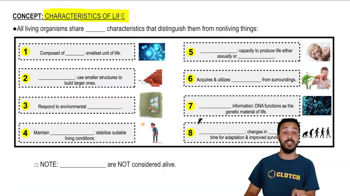
The cell is the smallest and most basic unit of structure and function in an organism.
Prokaryotic cells lack a nucleus and membrane-bound organelles; eukaryotic cells contain a nucleus and membrane-bound organelles.
Order, Regulation (Homeostasis), Energy Processing, Evolutionary Adaptation, Response to Environment, Reproduction, Growth and Development.
Evolution is the scientific explanation for the unity and diversity of organisms and their adaptation to environments.
Unity arises from common ancestry; diversity results from heritable changes after species diverge from common ancestors.
Darwin developed the theory of natural selection explaining how species evolve through descent with modification.
1. Descent with modification from common ancestors.
2. Natural selection as the mechanism for evolution.
Variation in traits, overproduction of offspring, competition, and adaptation to environments.
Process where individuals with advantageous traits survive and reproduce more, increasing those traits in the population.
Traits that enhance survival and reproduction in specific environments, such as camouflage or mimicry.
Bacteria, Archaea (both prokaryotes), and Eukarya (eukaryotes).
By hierarchical ranks: Domain, Kingdom, Phylum, Class, Order, Family, Genus, Species.
The combination of its Genus and Species names, e.g., Vulpes vulpes for the red fox.
The regulation of internal conditions to maintain a stable environment within an organism.
DNA regulates growth and development and carries genetic information for inheritance.
The global sum of all ecosystems where life exists on Earth.
They produce emergent properties that define the complexity and function of living systems.