 Indietro
General Biology: Unifying Themes and Basic Concepts
 02:09
02:09

Termini in questo insieme (21)
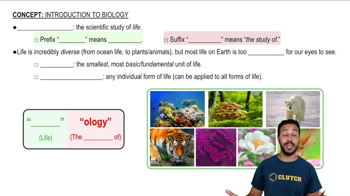
Biology is the scientific study of life, recognized by what living things do.
Organization, Information, Energy and Matter, Interactions, and Evolution.
Life can be studied at different levels, from molecules to the entire living planet, divided into levels of biological organization.
Reductionism is an approach that reduces complex systems to simpler components to study them more easily.
Emergent properties arise from the arrangement and interaction of parts as complexity increases, seen in both biological and nonbiological systems.
By complementing reductionism with systems biology, which analyzes interactions among parts of a biological system.
At each biological level, structure correlates with function; knowing one provides insight into the other.
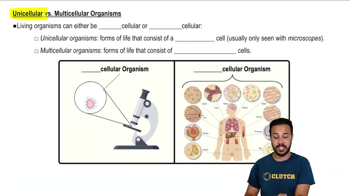
All living organisms are made of cells, which are the smallest units that perform all life activities.
Prokaryotic cells lack a nucleus and membrane-enclosed organelles; eukaryotic cells have a nucleus and organelles.
DNA is the genetic material in chromosomes that stores information for building molecules and directs organism development.
DNA is made of two long chains in a double helix, composed of nucleotides abbreviated A, G, C, and T.
DNA is transcribed into RNA, which is then translated into proteins; this process is called gene expression.
Genomics studies whole sets of genes in one or more species, analyzing entire genomes.
Proteomics studies whole sets of proteins expressed by cells, tissues, or organs, called the proteome.
High-throughput technology, bioinformatics, and interdisciplinary research teams enable large-scale DNA data analysis.
Energy from the sun is converted by producers into chemical energy, which flows to consumers and is lost as heat.
Chemicals are used and recycled within ecosystems, passing through organisms and the environment.
Interactions among components ensure smooth integration and function at all levels, from molecules to ecosystems.
Feedback regulation controls biological processes by using the output to regulate the process itself.
Negative feedback opposes the initial stimulus to maintain homeostasis, the most common regulation form in organisms.
Positive feedback reinforces or strengthens a stimulus, less common in biological regulation.