 Indietro
General Biology Unit 1 Key Concepts
 09:26
09:26
Termini in questo insieme (29)
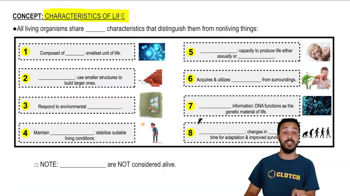
Order, reproduction, growth and development, energy processing, response to environment, regulation (homeostasis), evolutionary adaptation.
Atom, molecule, organelle, cell, tissue, organ, organ system, organism, population, community, ecosystem, biosphere.
New properties arise at each level of biological organization that were not present at the preceding level.
Cell; all 7 characteristics of life are present in cells; can be prokaryotic or eukaryotic.
Prokaryotic cells lack a nucleus and organelles; eukaryotic cells have a nucleus and organelles.
Genes are DNA segments containing instructions for making proteins, which carry out all cellular functions.
Archaea and Bacteria (prokaryotes), and Eukarya (eukaryotes).
Mechanism of evolution where organisms with favorable traits reproduce more successfully, passing traits to offspring.
Observation, hypothesis formation (inductive reasoning), prediction testing (deductive reasoning), theory development.
Matter has mass and takes up space; elements are substances with unique chemical properties that cannot be broken down.
Protons (positive, define element), neutrons (neutral, add mass), electrons (negative, orbit nucleus).
Atoms of the same element with different numbers of neutrons; some are radioactive.
Strong bonds where electrons are shared; can be nonpolar (equal sharing) or polar (unequal sharing).
Formed by attraction between oppositely charged ions created by electron transfer.
Weak bonds between polar regions of molecules due to partial charges from polar covalent bonds.
Cohesion: water molecules stick to each other; adhesion: water sticks to other surfaces; both aid transport in organisms.
Water absorbs a lot of heat before temperature rises, stabilizing temperatures in organisms and environments.
Ice is less dense than liquid water because hydrogen bonds form a crystal structure with fewer molecules per volume.
Water dissolves many substances due to its polarity and ability to form hydrogen bonds with other polar molecules.
Measures acidity/basicity from 0 (acidic) to 14 (basic); each unit is a 10-fold change in H+ concentration.
Substances that minimize pH changes by accepting or donating H+ ions, essential for maintaining homeostasis.
Carbon forms 4 bonds allowing diverse structures like chains, branches, rings, and double bonds.
Monomers are small units joined by dehydration reactions to form polymers; polymers broken down by hydrolysis.
Carbohydrates, lipids, proteins, nucleic acids.
Monosaccharides (fuel), disaccharides (energy), polysaccharides (energy storage and structure).
Hydrophobic molecules including fats (energy storage), phospholipids (membranes), and steroids (hormones).
Primary (amino acid sequence), secondary (alpha helices, beta sheets), tertiary (3D folding), quaternary (multiple polypeptides).
Made of nucleotides with phosphate, 5-carbon sugar, and nitrogenous base; DNA and RNA carry genetic information.
DNA: A pairs with T; G pairs with C. RNA: A pairs with U; G pairs with C.