 Indietro
General Biology - Unit 2 Key Concepts
 03:30
03:30
Termini in questo insieme (20)
From smallest to largest: atom, molecule, organelle, cell, tissue, organ, organ system, organism, population, community, ecosystem, biosphere.
Community is all populations of different species in an area; ecosystem includes the community plus the physical environment.
Bacteria and Archaea are prokaryotes; Eukarya includes eukaryotes like protists, plants, fungi, and animals.
A hypothesis is a testable prediction; a theory is a well-supported explanation based on evidence.
Independent variable is manipulated; dependent variable is measured in response.
Atom: smallest unit of matter; isotope: atoms with same protons but different neutrons; ion: atom with net charge due to electron loss/gain.
Ions form to achieve a full outer electron shell, increasing stability by gaining or losing electrons.
Ionic bonds: transfer of electrons; covalent bonds: sharing electrons; hydrogen bonds: weak attraction between polar molecules.
Polar covalent bonds have unequal electron sharing (e.g., water); nonpolar covalent bonds share electrons equally (e.g., O2).
pH measures H+ concentration; buffers maintain stable pH by neutralizing acids or bases, important in blood.
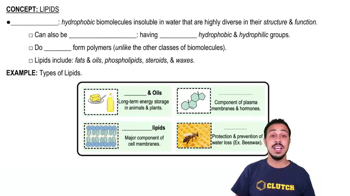
Contain carbon and hydrogen; include carbohydrates, lipids, proteins, and nucleic acids.
Condensation links monomers by removing water; hydrolysis breaks polymers by adding water.
Monosaccharide: single sugar (e.g., glucose); disaccharide: two sugars (e.g., sucrose); polysaccharide: many sugars (e.g., starch).
Starch: energy storage in plants; glycogen: energy storage in animals; cellulose: plant cell walls; chitin: insect exoskeletons.
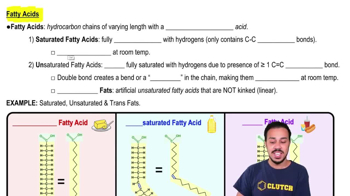
Saturated fats have no double bonds, solid at room temp; unsaturated fats have double bonds, liquid at room temp.
Formed by condensation of one glycerol and three fatty acids.
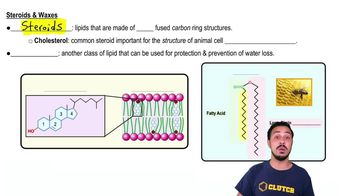
Phospholipids have two fatty acids and a phosphate group; triglycerides have three fatty acids.
Amino acids are protein monomers linked by peptide bonds.
Primary: amino acid sequence; Secondary: alpha helices and beta sheets; Tertiary: 3D folding; Quaternary: multiple polypeptides.
Enzymes have optimal pH; extreme pH can denature enzymes and reduce activity.