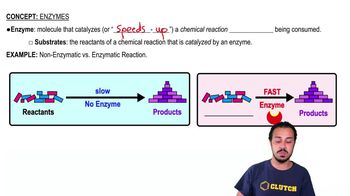
Enzymes speed up metabolic reactions by lowering the activation energy barrier required for the reaction to proceed.
What is the role of the enzyme active site?
The active site is where the enzyme binds specifically to its substrate, facilitating the chemical reaction.
Describe the enzyme-substrate interaction cycle.
Enzymes bind substrate, carry out the chemical reaction, release products, and are then available to bind more substrate.
What factors affect the rate of enzyme reactions?
Enzyme reaction rates are affected by enzyme concentration, substrate concentration, temperature, and pH.
Differentiate between enzyme activators and inhibitors.
Activators increase enzyme activity, while inhibitors decrease it. Inhibitors can be competitive or noncompetitive (allosteric).
What is the difference between cofactors and allosteric activators?
Cofactors are non-protein helpers required for enzyme activity; allosteric activators bind elsewhere on the enzyme to increase activity.
What is ATP and why is it important?
ATP is the molecule cells use to do work, storing energy in its three negatively charged phosphate groups.
How does ATP release energy for cellular work?
ATP releases energy by breaking the bond between its second and third phosphate groups, forming ADP.
Explain the ATP-ADP cycle.
ATP breaks down to ADP releasing energy; ADP is then recycled back to ATP by adding a phosphate group using energy.
What is cellular respiration?
A metabolic pathway that breaks down glucose to release energy used to form ATP.
Describe the mitochondrial structure relevant to cellular respiration.
The mitochondria have a double membrane creating the matrix and intermembrane space, with the inner membrane having a large surface area for ATP production.
What are the three stages of cellular respiration?
Glycolysis, Krebs (Citric Acid) Cycle, and Oxidative Phosphorylation (Electron Transport Chain).
Where does glycolysis occur and what are its products?
Glycolysis occurs in the cytoplasm, breaking glucose into 2 pyruvate molecules, producing a small amount of ATP and NADH.
Is ATP required to start glycolysis?
Yes, glycolysis requires an initial input of ATP to begin the process.
What happens to pyruvate before entering the Krebs cycle?
Pyruvate is converted into Acetyl CoA, releasing CO2 as a waste product.
Why does the Krebs cycle run twice per glucose molecule?
Because each glucose produces 2 pyruvate molecules, the cycle runs once per Acetyl CoA, totaling two cycles.
What gas is released during the Krebs cycle and from what molecule?
CO2 is released as a waste product from the breakdown of carbon molecules in Acetyl CoA.
What is the role of NADH and FADH2 in cellular respiration?
They are electron carriers that transport high-energy electrons from glycolysis and Krebs cycle to the electron transport chain.
Where does oxidative phosphorylation occur and what is its main function?
It occurs on the inner mitochondrial membrane and produces the majority of ATP by using energy from electrons passed through the electron transport chain.
What is the final electron acceptor in aerobic respiration?
Oxygen is the final electron acceptor, forming water after accepting electrons.
How does the electron transport chain generate ATP?
Electron movement pumps H+ ions into the intermembrane space, creating a gradient that powers ATP synthase to produce ATP.
What happens to the electron transport chain if oxygen is absent?
The ETC shuts down because there is no final electron acceptor, stopping ATP production via oxidative phosphorylation.
What is fermentation and why is it important?
Fermentation is anaerobic respiration that recycles NADH back to NAD+ to keep glycolysis running when oxygen is absent.
Differentiate between alcohol and lactic acid fermentation.
Alcohol fermentation produces ethanol and CO2; lactic acid fermentation produces lactic acid without CO2.
What is photosynthesis?
The process by which organisms use sunlight energy to build sugars from carbon dioxide and water.
Where does photosynthesis occur in plant cells?
In the chloroplast, specifically within the thylakoid membranes and stroma.
What are the two stages of photosynthesis?
Light Reactions (occur in thylakoid membranes) and Calvin Cycle (Dark Reactions, occur in the stroma).
What is the role of NADP+ in photosynthesis?
NADP+ acts as an electron carrier, transporting electrons from light reactions to the Calvin cycle.
Why do plants have multiple pigments?
Multiple pigments allow plants to absorb a broader range of light wavelengths for more efficient energy capture.
What is the purpose of stomata in leaves?
Stomata allow gas exchange, letting CO2 enter for photosynthesis and O2 exit as a byproduct.
How are ATP and NADPH used in the Calvin cycle?
They provide energy and electrons to convert CO2 into glucose; after use, they revert to ADP and NADP+.
How are photosynthesis and cellular respiration connected?
Photosynthesis produces glucose and oxygen used in cellular respiration; respiration produces CO2 and water used in photosynthesis.
 Indietro
 02:32