Skip to main content
General Biology
Il mio corso
Impara
Preparazione agli esami
AI Tutor
Guide di studio
Soluzioni per libri di testo
Flashcard
Esplora
Prova l'app
Il mio corso
Impara
Preparazione agli esami
AI Tutor
Guide di studio
Soluzioni per libri di testo
Flashcard
Esplora
Prova l'app
Indietro
General Biology: Water and Carbon Molecular Diversity
Puoi toccare per girare la carta.
What type of bonds form between water molecules?
Puoi toccare per girare la carta.
👆
What type of bonds form between water molecules?
Hydrogen bonds
form between water molecules due to polarity.
Avanzamenti del tracciato
I pulsanti di controllo sono stati cambiati in modalità "navigazione".
1/22
Video consigliati
01:54
Introduction to Water
24072
views
485
rank
1
comments
01:51
Introduction to Water Example 1
17739
views
278
rank
01:29
Emergent Properties of Water
20938
views
355
rank
Termini in questo insieme (22)
Nascondere definizioni
What type of bonds form between water molecules?
Hydrogen bonds
form between water molecules due to polarity.
Name four emergent properties of water.
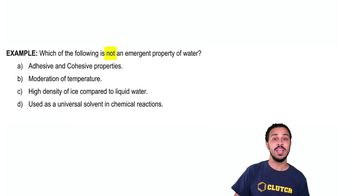
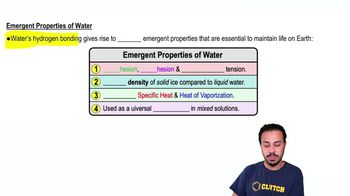
Cohesion, adhesion, moderation of temperature, and use as a universal solvent.
What causes water's cohesion and adhesion properties?
Water's polarity and ability to form
hydrogen bonds
cause cohesion and adhesion.
Why does ice float on liquid water?
Ice is less dense because stable hydrogen bonds form a lattice structure that spaces molecules farther apart.
What is the significance of ice floating for aquatic life?
Ice insulates liquid water below, allowing life to survive under frozen surfaces.
Define specific heat and its importance in water.
Specific heat is the energy needed to raise 1 gram of a substance by 1°C; water's high specific heat stabilizes temperatures.
What is heat of vaporization and why is it high for water?
Heat of vaporization is energy to convert liquid to gas; water's hydrogen bonds require more energy to break.
Why is water called the universal solvent?
Water dissolves many substances due to its polarity and ability to form hydration shells around solutes.
What is the difference between solute and solvent?
Solute is the substance dissolved; solvent is the substance doing the dissolving, usually water.
Define homogeneous and heterogeneous solutions.
Homogeneous solutions are uniformly mixed; heterogeneous solutions have unevenly distributed components.
What does hydrophilic mean?
Hydrophilic substances dissolve in water due to affinity, often polar or charged molecules.
What does hydrophobic mean?
Hydrophobic substances do not dissolve in water, usually nonpolar molecules like fats and oils.
How do acids affect hydrogen ion concentration in solution?
Acids increase the concentration of H+ ions in solution.
How do bases affect hydrogen ion concentration in solution?
Bases decrease H+ concentration by accepting H+ or releasing OH- ions.
What is the pH scale range and what does it measure?
pH ranges from 0 to 14 and measures the concentration of hydrogen ions in a solution.
What pH value is neutral and what does it mean for H+ and OH- concentrations?
pH 7 is neutral; H+ concentration equals OH- concentration.
What role do buffers play in biological systems?
Buffers resist changes in pH by donating or accepting H+ ions to maintain stable conditions.
Which element is the most abundant in living systems after water?
Carbon
is the most abundant element in living systems excluding water.
What defines an organic molecule?
Organic molecules contain covalently bonded carbon and hydrogen atoms.
Why is carbon an excellent building block for molecules?
Carbon forms four covalent bonds allowing diverse structures: varying length, branching, double bonds, and rings.
What are functional groups in organic molecules?
Functional groups are reactive groups of atoms attached to carbon backbones that determine molecule properties.
Name common biological functional groups.
Hydroxyl (-OH), carbonyl (C=O), carboxyl (-COOH), amino (-NH2), sulfhydryl (-SH), phosphate (-PO4), and methyl (-CH3).
 IndietroIndietro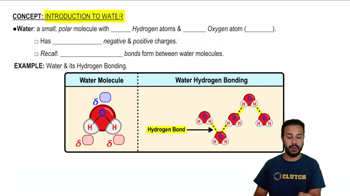
 01:54
01:54