Skip to main content
General Biology
Il mio corso
Impara
Preparazione agli esami
AI Tutor
Guide di studio
Soluzioni per libri di testo
Flashcard
Esplora
Prova l'app
Il mio corso
Impara
Preparazione agli esami
AI Tutor
Guide di studio
Soluzioni per libri di testo
Flashcard
Esplora
Prova l'app
Indietro
General Biology: Water and the Chemistry of Life
Puoi toccare per girare la carta.
What defines the atomic number of an element?
Puoi toccare per girare la carta.
👆
What defines the atomic number of an element?
Atomic number
is the number of
protons
in the nucleus of an atom.
Avanzamenti del tracciato
I pulsanti di controllo sono stati cambiati in modalità "navigazione".
1/25
Video consigliati
02:13
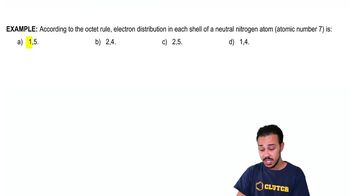
Atoms- Smallest Unit of Matter Example 1
30354
views
791
rank
2
comments
03:51
Atoms- Smallest Unit of Matter Example 3
19748
views
424
rank
1
comments
09:44
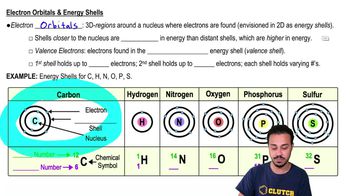
Electron Orbitals & Energy Shells
27479
views
588
rank
3
comments
Termini in questo insieme (25)
Nascondere definizioni
What defines the atomic number of an element?
Atomic number
is the number of
protons
in the nucleus of an atom.
What are isotopes?
Isotopes are forms of an element with the same number of protons but different numbers of
neutrons
.
What is the difference between Carbon-12 and Carbon-14?
Carbon-12 has 6 neutrons and is stable; Carbon-14 has 8 neutrons and is radioactive.
Why are isotopes important in science?
Isotopes help track compounds, determine structure by NMR, and are used in medical imaging like MRI.
Which elements make up over 99% of atoms in the human body?
Hydrogen (H), Carbon (C), Nitrogen (N), Oxygen (O), Phosphorus (P), and Sulfur (S).
What determines how elements bond?
The number and arrangement of
valence electrons
in the outermost electron shell.
What is a covalent bond?
A bond where valence electrons are
shared
between two atoms.
How do polar and nonpolar covalent bonds differ?
Polar bonds have unequal sharing of electrons due to differences in electronegativity; nonpolar bonds share electrons equally.
What is electronegativity?
An atom's
affinity for electrons
, increasing from left to right and bottom to top on the periodic table.
What is an ionic bond?
An attraction between oppositely charged ions formed by the transfer of electrons.
Define cation and anion.
A
cation
is a positively charged ion (loses electrons); an
anion
is negatively charged (gains electrons).
What is the difference between molecules and compounds?
Molecules are atoms held together by covalent bonds; compounds are molecules with atoms of different elements.
Why is water called the 'universal solvent'?
Because its polarity allows it to dissolve many polar and ionic substances.
What is a hydrogen bond?
A weak electrostatic attraction between a hydrogen atom with a partial positive charge and an electronegative atom like O or N.
List some unique properties of water due to hydrogen bonding.
High cohesion, surface tension, adhesion, high specific heat, and high heat of vaporization.
What is cohesion in water?
Attraction between water molecules due to hydrogen bonding, leading to high surface tension.
What is adhesion in water?
Attraction between water molecules and other substances, enabling capillary action.
What is specific heat?
The amount of energy required to raise the temperature of 1 gram of a substance by 1°C.
How does water dissociate spontaneously?
Water dissociates into
H3O+
(hydronium) and
OH-
(hydroxide) ions: 2 H2O ⇋ H3O+ + OH-.
Define acids and bases according to Brønsted theory.
Acids donate protons (H+); bases accept protons or donate hydroxide ions (OH-).
What is pH and how is it calculated?
pH measures proton concentration: \(pH = -\log[H^+]\).
What is the role of buffers in biological systems?
Buffers minimize pH changes by absorbing or releasing protons, maintaining homeostasis.
How does the carbonic acid buffer system regulate blood pH?
It shifts equilibrium between H2CO3, HCO3-, and CO2 to counteract pH changes.
Why does water have a high heat of vaporization?
Because hydrogen bonds require significant energy to break during evaporation.
What is the relative strength order of chemical bonds?
Covalent > Ionic > Hydrogen bonds > van der Waals interactions.
 IndietroIndietro
 02:13
02:13