 Indietro
General Biology: Water, Carbon, and Molecular Diversity
 05:03
05:03
Termini in questo insieme (26)
Water is polar because oxygen has a partial negative charge and hydrogen has a partial positive charge, creating an uneven distribution of electrons.
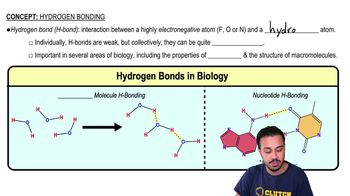
A single water molecule can form up to four hydrogen bonds with neighboring molecules.
Cohesion is the attraction between water molecules; adhesion is the attraction between water molecules and other substances.
Surface tension, a result of cohesion among water molecules, allows water striders to walk on water.
A calorie is the amount of heat required to raise the temperature of 1 gram of water by 1°C.
High specific heat means water can absorb or release a large amount of heat with little temperature change.
Hydrogen bonds absorb heat when they break and release heat when they form, stabilizing water's temperature.
It helps moderate Earth's climate and stabilizes temperatures in organisms and environments.
Evaporation is the change from liquid to gas; heat of vaporization is the heat required for this change.
Ice is less dense than liquid water due to hydrogen bonding; 4°C is the temperature where water is densest.
Solvent dissolves substances, solute is dissolved, and solution is the mixture.
Water's polarity allows it to surround and dissolve many solutes, especially ionic and polar molecules.
Hydrophobic substances repel water; hydrophilic substances attract and dissolve in water.
Molarity is the number of moles of solute per liter of solution.
Water dissociates into hydronium (H3O+ or H+) and hydroxide (OH–) ions.
Pure water has a pH of 7 because the concentrations of H+ and OH– ions are equal.
The pH scale is logarithmic; each unit change represents a 10-fold change in H+ concentration.
A buffer minimizes pH changes by accepting or donating H+ ions.
It showed that organic molecules could form under early Earth conditions.
Carbon has 4 valence electrons and can form 4 covalent bonds with other atoms.
Hydrocarbons are molecules of only carbon and hydrogen; they are hydrophobic.
Isotope: atoms with different neutron numbers (e.g., Carbon-12, Carbon-14). Isomer: molecules with same formula but different structures (e.g., glucose and fructose).
A functional group is a specific group of atoms that confers characteristic properties to molecules.
Hydroxyl (-OH): polar; Carboxyl (-COOH): acidic; Amino (-NH2): basic.
Changing functional groups changes molecule shape and chemical behavior, affecting function.
Enantiomers of drugs can have different pharmacological effects, such as the two forms of thalidomide.