 Indietro
Hierarchy of Biological Organization
 09:50
09:50
Termini in questo insieme (15)
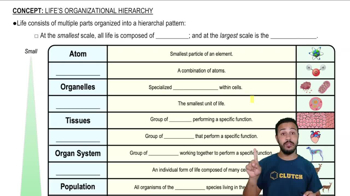
Cell is the smallest unit of life that can function independently.
Organelles are specialized structures within a cell that perform distinct functions.
Tissues are groups of similar cells that work together to perform a specific function.
An organ is a structure made of different tissues working together to perform a particular function.
An organ system is a group of organs that work together to carry out complex functions.
A multicellular organism is made up of many cells organized into tissues, organs, and systems.
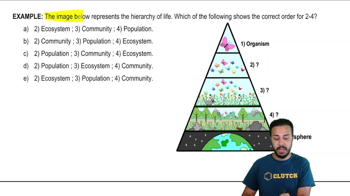
A population is a group of individuals of the same species living in a specific area.
A community consists of all the populations of different species living and interacting in an area.
An ecosystem includes all living organisms in an area plus the nonliving components of their environment.
Molecules are groups of atoms bonded together, forming the chemical basis of life.
Atoms form molecules, which build organelles, then cells, tissues, organs, organ systems, and finally a multicellular organism.
Organelles perform specific tasks such as energy production, protein synthesis, and waste processing inside the cell.
Tissues combine to form organs, enabling specialized functions necessary for survival.
A population is a single species group, while a community includes multiple populations interacting in one area.
An ecosystem includes both the community of living organisms and the physical environment they inhabit.