 Indietro
lab3-Macromolecule
 01:17

Termini in questo insieme (25)
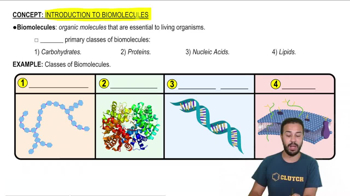
A macromolecule is a large molecule composed of many smaller subunits called monomers linked by dehydration synthesis.
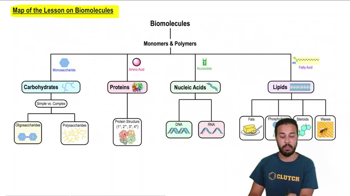
Proteins, carbohydrates, lipids, and nucleic acids.
A process where a water molecule is removed to form a covalent bond between two monomers.
Hydroxyl (-OH), ketone (-CO), and aldehyde (-CHO) groups.
\(C_nH_{2n}O_n\)
Smallest carbohydrate molecules, simple sugars like glucose, fructose, and galactose, which can exist as ring or straight chains.
By joining two monosaccharides via dehydration synthesis forming a glycosidic bond.
The orientation of the hydroxyl group at the number 1 carbon.
Long chains of 3 or more carbohydrates joined by dehydration synthesis; they provide energy storage and structural support.
Starch (energy storage in plants), glycogen (energy storage in animals), cellulose (structural support in plants).
Because it contains beta glycosidic linkages that humans cannot break down.
A sugar with a free or potentially free aldehyde or ketone group that can reduce copper sulfate in Benedict's test.
Detects reducing sugars by reacting copper sulfate with the sugar to form cuprous oxide, causing a color change from green to red depending on concentration.
To distinguish monosaccharides from disaccharides and polysaccharides by using copper ions at lower pH and shorter reaction time.
Presence of polysaccharides like starch, which turn blue-black when reacting with iodine.
Lipids include triglycerides, phospholipids, and steroids; they are hydrophobic or insoluble in water.
One glycerol molecule covalently bound to three fatty acid molecules.
Phospholipids have a phosphate group replacing one fatty acid chain, important for cell membranes.
To detect lipids by staining hydrophobic substances red.
A test for lipids where grease leaves a translucent spot on brown paper, unlike water.
Chains of amino acids linked by peptide bonds formed via dehydration synthesis.
Amino group (NH2), carboxyl group (COOH), and a variable alkyl group (R).
The covalent bond formed between amino acids in a protein chain.
To detect proteins by reacting with peptide bonds to produce a violet color.
No, only chains of more than six amino acids react.