Skip to main content
General Biology
Il mio corso
Impara
Preparazione agli esami
AI Tutor
Guide di studio
Soluzioni per libri di testo
Flashcard
Esplora
Prova l'app
Il mio corso
Impara
Preparazione agli esami
AI Tutor
Guide di studio
Soluzioni per libri di testo
Flashcard
Esplora
Prova l'app
Indietro
Lecture 8a-for Exam 3-Mitosis & Cell Cycle
Puoi toccare per girare la carta.
What is the primary purpose of cell division?
Puoi toccare per girare la carta.
👆
What is the primary purpose of cell division?
Cell division
is essential for reproduction, growth, embryonic development, renewal, and repair in living organisms.
Avanzamenti del tracciato
I pulsanti di controllo sono stati cambiati in modalità "navigazione".
1/24
Video consigliati
04:46
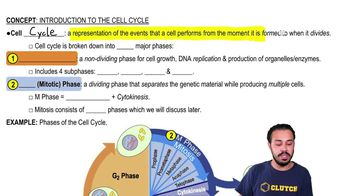
Introduction to the Cell Cycle
21201
views
339
rank
1
comments
Termini in questo insieme (24)
Nascondere definizioni
What is the primary purpose of cell division?
Cell division
is essential for reproduction, growth, embryonic development, renewal, and repair in living organisms.
What is a genome?
The
genome
is all the DNA in a cell, which can be a single DNA molecule in prokaryotes or multiple molecules in eukaryotes.
What is chromatin?
Chromatin
is a complex of DNA and protein that condenses to form chromosomes during cell division.
Define sister chromatids.
Sister chromatids are identical copies of a chromosome, joined at the centromere before cell division.
What are the two main processes of eukaryotic cell division?
Mitosis
divides the genetic material in the nucleus, and
cytokinesis
divides the cytoplasm.
What is the mitotic spindle and its function?
The
mitotic spindle
is made of microtubules that control chromosome movement during mitosis.
What happens during metaphase of mitosis?
Chromosomes line up at the metaphase plate, an imaginary plane midway between the spindle's two poles.
How do sister chromatids separate during anaphase?
Cohesins are cleaved by separase, allowing sister chromatids to move along kinetochore microtubules to opposite poles.
How does cytokinesis differ in animal and plant cells?
In animal cells, a cleavage furrow forms; in plant cells, a cell plate forms to divide the cells.
What is binary fission?
Binary fission is prokaryotic cell division where the chromosome replicates and the cell splits into two daughter cells.
What are the phases of mitosis?
Prophase, prometaphase, metaphase, anaphase, and telophase.
What is the role of cyclins and CDKs in cell cycle control?
Cyclins bind to cyclin-dependent kinases (CDKs) to activate them, regulating progression through the cell cycle.
What is MPF and its function?
Maturation-promoting factor (MPF) is a cyclin-CDK complex that triggers the cell's passage from G2 phase into mitosis.
What happens at the G1 checkpoint?
The cell decides whether to divide, enter G0 (non-dividing state), or continue the cycle based on internal and external signals.
How do cancer cells differ in cell cycle regulation?
Cancer cells can divide without normal growth signals, may produce their own growth factors, or have abnormal cell cycle control.
What is meiosis and its purpose?
Meiosis is a type of cell division producing four genetically distinct haploid gametes for sexual reproduction.
What are homologous chromosomes?
Pairs of chromosomes, one from each parent, that have the same length, centromere position, and genes controlling the same traits.
What occurs during prophase I of meiosis?
Homologous chromosomes pair and crossing over occurs at chiasmata, exchanging genetic material.
How does meiosis I differ from meiosis II?
Meiosis I separates homologous chromosomes; meiosis II separates sister chromatids.
What are three mechanisms that contribute to genetic variation?
Independent assortment of chromosomes, crossing over, and random fertilization.
What is independent assortment?
Random orientation of homologous chromosome pairs at metaphase I, producing 2^n possible chromosome combinations.
What is crossing over?
Exchange of genetic material between homologous chromosomes during prophase I, creating recombinant chromosomes.
Why is random fertilization important?
Any sperm can fuse with any egg, increasing genetic variation in offspring.
What is the evolutionary significance of genetic variation?
Genetic variation provides material for natural selection, enabling populations to adapt to changing environments.
 IndietroIndietro
 04:46
