Skip to main content
General Biology
Il mio corso
Impara
Preparazione agli esami
AI Tutor
Guide di studio
Soluzioni per libri di testo
Flashcard
Esplora
Prova l'app
Il mio corso
Impara
Preparazione agli esami
AI Tutor
Guide di studio
Soluzioni per libri di testo
Flashcard
Esplora
Prova l'app
Indietro
Lecture 9(b)-for xm 3-Molecular Genetics
Puoi toccare per girare la carta.
What did T.H. Morgan's group discover about genes?
Puoi toccare per girare la carta.
👆
What did T.H. Morgan's group discover about genes?
They showed that genes are located on chromosomes and identified DNA and protein as candidates for genetic material.
Avanzamenti del tracciato
I pulsanti di controllo sono stati cambiati in modalità "navigazione".
1/21
Video consigliati
08:56
The Griffith Experiment
18493
views
273
rank
Termini in questo insieme (21)
Nascondere definizioni
What did T.H. Morgan's group discover about genes?
They showed that genes are located on chromosomes and identified DNA and protein as candidates for genetic material.
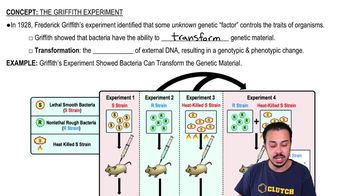
What phenomenon did Frederick Griffith discover in 1928?
Transformation
: a change in genotype and phenotype due to uptake of foreign DNA.
What was the key finding of Hershey and Chase's 1952 experiment?
DNA, not protein, is the genetic material injected by bacteriophages into bacteria.
What are the four nitrogenous bases in DNA?
Adenine (A), Thymine (T), Guanine (G), and Cytosine (C).
What is Chargaff's Rule?
In any species, the amount of adenine equals thymine, and the amount of guanine equals cytosine.
What technique did Rosalind Franklin use to study DNA structure?
X-ray crystallography, which produced images revealing DNA's helical structure.
What did Watson and Crick deduce about DNA structure?
DNA is a double helix with two antiparallel sugar-phosphate backbones and specific base pairing: A with T, G with C.
What is the significance of base pairing in DNA replication?
Each strand serves as a template for a new complementary strand, enabling accurate copying.
Describe the semiconservative model of DNA replication.
Each daughter DNA molecule has one old (parental) strand and one newly synthesized strand.
What enzyme unwinds the DNA double helix at the replication fork?
Helicase
untwists the double helix to separate the strands.
What role do single-strand binding proteins play in DNA replication?
They bind and stabilize single-stranded DNA to prevent reannealing.
What is the function of primase in DNA replication?
Synthesizes a short RNA primer to provide a starting point for DNA polymerase.
In which direction does DNA polymerase add nucleotides?
Only to the free 3′ end, synthesizing DNA in the 5′ → 3′ direction.
What are Okazaki fragments?
Short DNA segments synthesized discontinuously on the lagging strand.
How are Okazaki fragments joined together?
DNA ligase joins the fragments by forming phosphodiester bonds.
What is the role of topoisomerase during DNA replication?
Relieves strain ahead of the replication fork by breaking and rejoining DNA strands.
How does DNA polymerase proofread newly synthesized DNA?
It removes incorrectly paired nucleotides and replaces them with correct ones.
What is the function of telomeres?
Protect chromosome ends from erosion during replication by postponing gene loss.
What enzyme lengthens telomeres in germ cells?
Telomerase
catalyzes the addition of repetitive nucleotide sequences to telomeres.
How do bacterial chromosomes differ from eukaryotic chromosomes?
Bacterial chromosomes are circular and supercoiled; eukaryotic chromosomes are linear and packaged with histone proteins.
What is a nucleosome?
A bead-like unit of chromatin consisting of DNA wrapped around histone proteins.
 IndietroIndietro
 08:56
