 Indietro
Lipids, Membranes, and Membrane Transport in General Biology
 03:30

Termini in questo insieme (50)
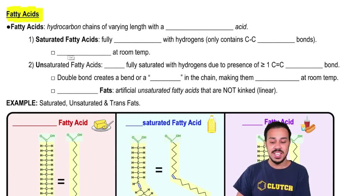
What is the difference between saturated and unsaturated fatty acids? Which is healthier?
Saturated fatty acids have only single bonds between carbons and maximum hydrogen atoms, while unsaturated fatty acids have one or more double bonds causing kinks in the chain.
Unsaturated fats b/c double bonds
Name the three most important types of lipids found in cells. Does lipid structure vary?
Steroids, fats (triacylglycerols), and phospholipids
Yes, very. Hydrocarbon skeleton can be put together in many different ways
Phospholipids have both
Hydrophilic (polar, head) region with a glycerol and a phosphate group.
Hydrophobic (nonpolar, tail) region made of a hydrocarbon chain.
Allows them to form plasma membranes
What structures do amphipathic lipids form in water? Are they insoluble or soluble?
Amphipathic lipids form micelles (spherical aggregates - circle - vesicles) or lipid bilayers (paired sheets) spontaneously in water.
Insoluble: the hydrophilic head interacts with water; the hydrophobic tail does not
What is selective permeability in lipid bilayers? Examples?
Selective permeability means small or nonpolar molecules cross phospholipid bilayers quickly, while charged or large polar substances cross slowly or not at all.
Oxygen - small & nonpolar; moves across quickly
Glucose - large & polar; moves slower across
How do hydrocarbon tail length and saturation affect membrane permeability?
Longer and saturated hydrocarbon tails increase hydrophobic interactions, making membranes denser and less permeable (longer & denser tails = less permeable)
Unsaturated tails with kinks weaken the barrier and increase permeability.
Diffusion is the spontaneous movement of molecules from high to low concentration along a concentration gradient, increasing entropy.
Concentration gradient created by a difference in solute concentrations
Osmosis is the diffusion of water across a selectively permeable membrane from low to high solute concentration to equalize solute concentrations.
Hypertonic solutions have higher solute concentration outside the cell, causing water to exit; hypotonic solutions have lower solute concentration inside the cell, so water enters; isotonic solutions have equal solute concentrations.
Hypo - bursts
Isotonic - equilibrium
Hyper -shrinks
The cell membrane is flexible, with proteins scattered throughout it that can move around.
Proteins embedded in cell mem. that help transport substances across it, receive signals, or perform other cell functions.
Integral = embedded in membrane.
Peripheral proteins = attached to surface of the membrane (outside or inside cell) that help w/ cell signaling, support, & other functions.
Most lipids and some proteins move sideways within the membrane, but flip-flopping across layers is rare.
What roles do channel proteins play in membranes? Give an example
Channel proteins form pores allowing selective ions or small molecules to diffuse passively across membranes
Aquaporins ("water pores") - allow water to cross plasma membrane
What are gated channels and how are they regulated? Example?
Gated channels open or close in response to signals like molecule binding or voltage changes, regulating ion and molecule flow.
Aquaporin
Secondary active transport uses energy stored in electrochemical gradients created by pumps to move other molecules against their gradients without direct ATP use.
Gradients represent potential energy
Why is selective permeability important for cells?
What are hydrocarbons? What are isoprenoids?
Non-polar molecules that contain only carbon and hydrogen; C-H bonds; hydrophobic
Polymer of hydrocarbons--hydrocarbon chain; building blocks for complex lipids
What is a fatty acid? Structure?
Hydrocarbon chain bonded to a carboxly (-COOH) group; contains 14-20 carbon atoms; can be saturated or unsaturated
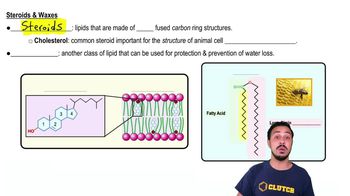
Structure of steroids? Examples?
Lipid
Bulky, four-ring structure
Differ from each other by attached functional groups
Estrogen, testosterone, cholesterol
Structure of fats? Primary role? Are they polymers?
3 fatty acids linked to a glycerol (aka triacylglycerols, triglycerides)
Energy storage bc large number of high-energy bonds
No
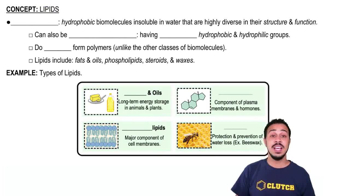
Functions of lipids?
Store chemical energy, act as pigments for photosynthesis, signal between cells, form waterproof coatings on skin & cells, act as vitamins in cellular processes.
What are vesicles? Liposomes?
Vesicles: small membrane-bound sacs (a lipid bilayer enclosing an aqueous interior).
Liposomes: artificial (lab-made) membrane-bound vesicles formed from phospholipid bilayers.
Liposomes are a type of vesicle!
What is the difference between concentration and solute concentration? Give an example of a process for each
Concentration = amount of a substance in a solution. Solute concentration = amount of dissolved substance.
Osmosis - water moves from low to high solute concentration
Diffusion -particles move from high to low concentration.
What is used to measure permeability of lipid bilayers?
Planar bilayers - lipid bilayers constructed across a hole in a glass or plastic wall, separating two aqueous solutions
How do phospholipids in plasma membranes move in the bilayer?
Laterally/sideways
Why are dissolved solutes in constant random motion?
Due to their thermal energy, which causes particles to move randomly. The higher the temperature, the faster they generally move.
What is equilibrium? What is passive transport?
Occurs when molecules or ions are randomly distributed throughout a solution; molecules are still moving, but no net movement.
Occurs when substances diffuse across a membrane in the absence of an outside energy source
What are the main types of cell membrane transport?
Passive transport - occurs without energy
Simple diffusion
Facilitated diffusion
Osmosis
Active transport - requires energy
Facilitated diffusion vs. simple diffusion
Simple diffusion: Small molecules move from high to low concentration directly through the membrane (ex: oxygen).
Facilitated diffusion: Molecules move from high to low concentration through a channel or carrier protein (ex: glucose).
How do plant cells behave in a hypotonic solution and a hypertonic solution? How do red blood cells act in hypertonic solutions?
Plant cells become turgid (swollen), but do not lyse (burst) in hypotonic solutions; in hypertonic solutions, the plasma membrane and cytoplasm pull away (shrink away) from the rigid cell wall (aka - plasmolysis)
Red blood cells will undergo crenation (shrink and develop spiked or wrinkled margins)
What is the role of phospholipids and proteins in the membrane?
Phospholipids form the structure; proteins help substances cross.
What does amphipathic mean, and how do proteins form passageways across the lipid bilayer?
Amphipathic means having hydrophilic and hydrophobic regions. Protein folding creates shapes that can form passageways.
What are protocells?
Simple vesicle-like structures harboring nucleic acids, possible intermediates in cell evolution. Their permeable fatty-acid bilayers let nucleotides enter, allowing RNA to be synthesized inside.
What detergents? What proteins effect permability?
Small amphipathic molecules that can form micelles; can separate membrane proteins from the membrane (often used to isolate & study those proteins); water-soluble
Allowed identification of different membrane proteins
Channels, carriers, pumps (push substances)
What are ion channels? What are electrochemical gradients?
Specialized membrane proteins; form pores, or openings, in membrane; allow ions to cross membrane
Occurs when ions build up on one side of plasma membrane; Ions diffuse down their electrochemical gradient
What is cystic fibrosis & what is it caused by?
Secretions of cells that produce mucus, sweat, and digestive juices become abnormally concentrated & block pathways
Caused by defects in the transmembrane protein CFTR (cystic fibrosis conductance
transmembrane regulator) which allows passage of chloride ions (Cl-)
How does glucose diffuse across a membrane?
Carrier protein named GLUT-1 increases membrane permeability to glucose; it changes shape when it binds to glucose and allows its diffusion across the membrane