What is the primary function of the plasma membrane?
Separates life from nonlife, acts as a selective barrier allowing entry of needed materials, keeping damaging materials out, and facilitating necessary chemical reactions.
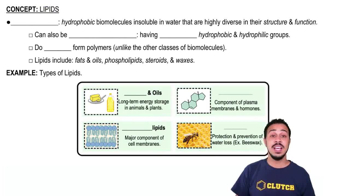
What defines lipids chemically?
Carbon-containing compounds insoluble in water due to a high proportion of nonpolar bonds.
What are hydrocarbons and their property?
Nonpolar molecules containing only carbon and hydrogen, making them hydrophobic.
What is an isoprenoid and its biological roles?
A hydrocarbon chain that functions as pigments, scents, vitamins, sex hormone precursors, and building blocks for complex lipids.
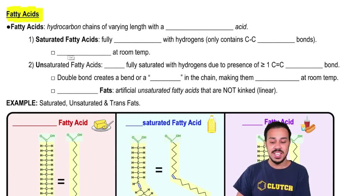
What is a fatty acid?
A hydrocarbon chain bonded to a polar carboxyl (–COOH) functional group, typically containing 14–20 carbon atoms.
Difference between saturated and unsaturated fatty acids?
Saturated fatty acids have only single bonds and maximum hydrogens; unsaturated have one or more double bonds causing kinks in the chain.
How does bond saturation affect the physical state of lipids?
Highly saturated lipids are solid at room temperature; highly unsaturated lipids are liquid at room temperature.
Name three important types of lipids found in cells.
Steroids, fats (triacylglycerols), and phospholipids.
What structural feature defines steroids?
A bulky, four-ring hydrocarbon structure with varying functional groups.
What is the primary role of fats (triacylglycerols)?
Energy storage due to a large number of high-energy bonds in fatty acid chains.
How are fats formed chemically?
By dehydration reactions linking three fatty acids to glycerol via ester linkages.
What distinguishes phospholipids from fats?
Phospholipids have a glycerol linked to a phosphate group and two hydrocarbon tails, making them amphipathic.
What does amphipathic mean in the context of phospholipids?
Molecules containing both hydrophilic (water-attracting) heads and hydrophobic (water-repelling) tails.
What structures do amphipathic lipids form in water?
Micelles (spherical aggregates) and lipid bilayers (paired sheets).
What are liposomes?
Artificial membrane-bound vesicles formed from phospholipids in the lab.
What is selective permeability of lipid bilayers?
Ability to allow small or nonpolar molecules to cross quickly, while charged or large polar molecules cross slowly or not at all.
How does hydrocarbon tail length affect membrane permeability?
Longer tails increase hydrophobic interactions, making membranes less permeable.
How does saturation of hydrocarbon tails affect membrane permeability?
 Indietro
 03:30