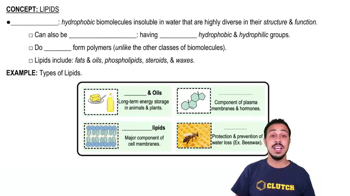
Lipids are not made from repeating monomer units and do not form long chains of repeating subunits, unlike proteins or nucleic acids.
What makes lipids hydrophobic?
Lipids have mostly nonpolar hydrocarbon chains that form nonpolar covalent bonds, causing them to repel water.
What are the three main types of biologically important lipids?
Fats (energy storage), phospholipids (cell membranes), and steroids (hormones and structural molecules).
What two smaller molecules compose a fat?
A fat is built from glycerol (a three-carbon alcohol) and fatty acids joined by dehydration reactions.
What is the structure of a fatty acid?
A fatty acid has a carboxyl group (-COOH) at one end and a long hydrocarbon chain (16-18 carbons) that is mostly nonpolar.
How is a fat (triacylglycerol) formed?
Three fatty acids are attached to one glycerol molecule by ester linkages through dehydration reactions.
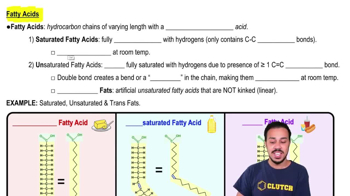
What is the difference between saturated and unsaturated fatty acids?
Saturated fatty acids have no double bonds and pack tightly, solid at room temperature; unsaturated fatty acids have one or more cis double bonds causing kinks, making them liquid.
Why are unsaturated fats liquid at room temperature?
The cis double bonds create kinks in the hydrocarbon chains, preventing tight packing and keeping them liquid.
What health implications are associated with saturated fats?
High intake of saturated fats may lead to cardiovascular disease due to plaque deposits in arteries.
What is the primary function of fats in animals?
Fats serve as long-term energy storage, cushion vital organs, and provide insulation.
What are adipose cells?
Specialized cells that store fat, swelling or shrinking as fat is added or used.
What is the structure of a phospholipid?
A phospholipid consists of two fatty acid tails (hydrophobic), a phosphate group (hydrophilic), and a glycerol backbone.
What does amphipathic mean in phospholipids?
Phospholipids have both hydrophobic tails and a hydrophilic head, allowing them to form bilayers in water.
How do phospholipids arrange themselves in water?
They self-assemble into a bilayer with hydrophilic heads facing water and hydrophobic tails shielded inside.
What is the biological importance of phospholipids?
They are the major component of cell membranes, essential for compartmentalization, membrane fluidity, and selective permeability.
What are steroids and their structure?
Steroids are lipids with four fused carbon rings and different functional groups, including cholesterol and hormones.
What role does cholesterol play in cells?
Cholesterol is a component of animal cell membranes and affects membrane fluidity and stability.
How do saturated and trans fats affect health?
Both can raise cholesterol levels and contribute to cardiovascular disease.
What is an ester linkage in fats?
A bond formed between glycerol and fatty acids by dehydration, linking the molecules in a fat.
What causes the kink in unsaturated fatty acid chains?
The cis double bond causes bending, preventing tight packing of the chains.
 Indietro
 03:30
03:30