 Indietro
Macromolecules and Protein Structure in General Biology
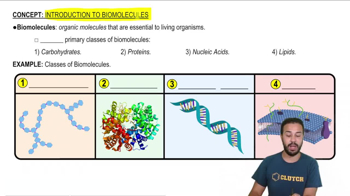
 01:17
01:17
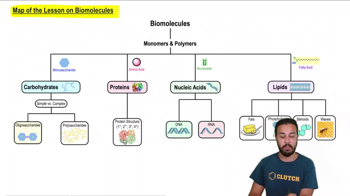
Termini in questo insieme (20)
Monosaccharides are the monomers of carbohydrates.
Glycosidic bonds link monosaccharides to form carbohydrates.
Carbohydrates provide energy storage and structural support.
Amino acids are the monomers of proteins.
Peptide bonds link amino acids to form proteins.
Primary, secondary, tertiary, and quaternary structures.
The sequence of amino acids in a polypeptide chain.
Local folding into alpha helices and beta sheets stabilized by hydrogen bonds.
The 3D folding of a polypeptide due to interactions among side chains.
The assembly of multiple polypeptide chains into a functional protein complex.
Nucleotides are the monomers of nucleic acids.
Phosphodiester bonds link nucleotides in nucleic acids.
Storage and transmission of genetic information.
Mostly hydrocarbon chains and glycerol or other backbones.
Because they are not made of repeating monomer units linked by covalent bonds.
Nonpolar covalent bonds dominate, especially in hydrocarbon chains.
Energy storage, membrane structure, and signaling.
Protein function depends on its correct folding at all structural levels.
The protein may lose its function due to misfolding or denaturation.
They stabilize secondary structures like alpha helices and beta sheets.