Skip to main content
General Biology
Il mio corso
Impara
Preparazione agli esami
AI Tutor
Guide di studio
Soluzioni per libri di testo
Flashcard
Esplora
Prova l'app
Il mio corso
Impara
Preparazione agli esami
AI Tutor
Guide di studio
Soluzioni per libri di testo
Flashcard
Esplora
Prova l'app
Indietro
Meiosis and Genetic Variation in General Biology
Puoi toccare per girare la carta.
What is meiosis?
Puoi toccare per girare la carta.
👆
What is meiosis?
Meiosis
is a type of cell division that reduces the chromosome number by half, producing four haploid daughter cells from one diploid parent cell.
Avanzamenti del tracciato
I pulsanti di controllo sono stati cambiati in modalità "navigazione".
1/20
Video consigliati
04:14
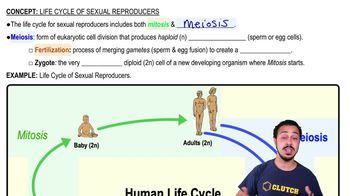
Life Cycle of Sexual Reproducers
12995
views
148
rank
Termini in questo insieme (20)
Nascondere definizioni
What is meiosis?
Meiosis
is a type of cell division that reduces the chromosome number by half, producing four haploid daughter cells from one diploid parent cell.
How many rounds of cell division occur in meiosis?
Meiosis consists of
two rounds
of cell division: Meiosis I and Meiosis II.
What happens during Meiosis I?
Homologous chromosomes separate during anaphase I, reducing the ploidy from diploid (2n) to haploid (n), but chromosomes remain duplicated.
What happens during Meiosis II?
Sister chromatids separate during anaphase II, but the ploidy remains haploid (n) because chromosomes are no longer duplicated.
What is the difference between meiosis and mitosis in terms of daughter cells?
Meiosis produces
four haploid
genetically distinct daughter cells, while mitosis produces
two diploid
identical daughter cells.
What is crossing over and when does it occur?
Crossing over
is the exchange of genetic material between homologous chromosomes during prophase I, increasing genetic variation.
What is independent assortment?
Independent assortment is the random distribution of maternal and paternal chromosomes into gametes during meiosis, contributing to genetic diversity.
How many possible chromosome combinations can humans produce through independent assortment?
Humans have 23 homologous pairs, leading to \(2^{23}\) (about 8.4 million) possible combinations.
How does fertilization affect chromosome number?
Fertilization restores the diploid chromosome number (2n) by fusing two haploid gametes (n).
What is nondisjunction?
Nondisjunction is the failure of homologous chromosomes or sister chromatids to separate properly during meiosis, causing aneuploidy.
What are the consequences of nondisjunction during meiosis I?
Nondisjunction in meiosis I results in gametes with an extra chromosome or missing one, affecting all resulting cells.
What are the consequences of nondisjunction during meiosis II?
Nondisjunction in meiosis II affects only half of the gametes, producing some with abnormal chromosome numbers.
What is a bivalent in meiosis?
A
bivalent
is a paired set of homologous chromosomes physically connected during prophase I.
What is a chiasma?
A
chiasma
is the site where crossing over occurs between non-sister chromatids of homologous chromosomes.
How do mitosis and meiosis differ in the number of cell divisions?
Mitosis involves
one
cell division; meiosis involves
two
cell divisions.
What is the role of meiosis in the organism life cycle?
Meiosis produces haploid gametes for sexual reproduction, halving chromosome number to maintain stability across generations.
What is the role of mitosis in the organism life cycle?
Mitosis supports growth, tissue repair, and asexual reproduction by producing genetically identical diploid cells.
What is synapsis?
Synapsis is the pairing of homologous chromosomes during prophase I of meiosis.
What is the difference in DNA content between daughter cells after mitosis and meiosis?
After mitosis, daughter cells have the same DNA content as the parent; after meiosis, daughter cells have half the DNA content.
What is the significance of sister chromatid separation in meiosis II?
Separation of sister chromatids in meiosis II ensures each gamete receives one copy of each chromosome.
 IndietroIndietro
 04:14
