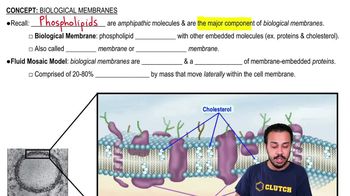
The membrane is a dynamic fluid mosaic of amphipathic phospholipids and mobile proteins that forms the cell's boundary and facilitates molecular communication.
Phospholipid Bilayer
A double layer of phospholipids with hydrophilic heads facing outward and hydrophobic tails inward, forming a hydrophobic barrier in water.
Membrane Fluidity Regulation
Cholesterol acts as a fluidity buffer by restraining phospholipid movement at high temperatures and preventing tight packing at low temperatures.
Integral vs Peripheral Proteins
Integral proteins penetrate the hydrophobic core, often as transmembrane proteins, while peripheral proteins are loosely bound to the membrane surface.
Functions of Membrane Proteins
Membrane proteins facilitate selective transport, enzymatic catalysis, signal transduction, cell-cell recognition, intercellular joining, and attachment to the cytoskeleton or ECM.
Selective Permeability
The hydrophobic core allows nonpolar molecules to pass easily but blocks hydrophilic substances, requiring transport proteins for their passage.
Facilitated Diffusion
Transport proteins such as channel and carrier proteins provide hydrophilic pathways for molecules that cannot cross the lipid bilayer directly.
Aquaporins
Specialized channel proteins that allow rapid passage of water molecules across the membrane.
Diffusion
The passive movement of molecules from an area of higher concentration to lower concentration until dynamic equilibrium is reached.
Osmosis
The passive diffusion of water across a selectively permeable membrane toward the side with higher solute concentration.
Osmoregulation
The process by which cells control internal solute concentrations and water balance, often using contractile vacuoles to pump out excess water.
Turgor Pressure
The pressure exerted by the rigid plant cell wall against the influx of water in a hypotonic environment, keeping the cell firm.
Active Transport
The use of ATP to pump solutes against their concentration gradients via specific carrier proteins.
Sodium-Potassium Pump
An electrogenic pump that uses ATP to exchange Na+ and K+ ions across the membrane, generating membrane potential.
Cotransport
A mechanism where the downhill diffusion of one solute powers the uphill transport of another solute against its gradient.
Membrane Potential
A voltage across the membrane created by electrogenic pumps, storing potential energy for cellular work.
Exocytosis
The process by which cells export large molecules by fusing transport vesicles with the plasma membrane.
Endocytosis
The process of capturing external materials by inward folding of the plasma membrane to form vesicles.
Phagocytosis vs Pinocytosis
Phagocytosis engulfs large particles like bacteria, while pinocytosis non-selectively 'gulps' extracellular fluid and solutes.
Receptor-Mediated Endocytosis
Selective uptake of specific solutes by binding to membrane receptors, forming coated vesicles for internalization.
 Indietro
 02:21
02:21