 Indietro
Membrane Transport and Cell Signaling
 02:33

Termini in questo insieme (20)
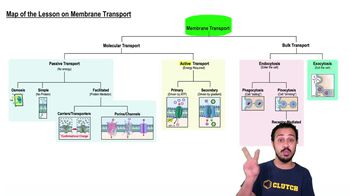
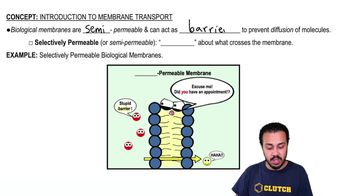
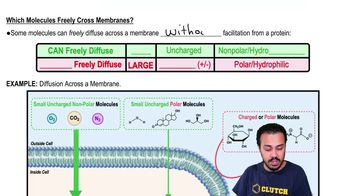
Membrane transport is the movement of substances across a cell membrane, allowing cells to import nutrients and export waste.
Passive transport (no energy required) and active transport (energy required).
Movement of molecules across a membrane without energy input, down their concentration gradient.
Diffusion is the passive movement of molecules from an area of higher concentration to lower concentration.
Osmosis is the diffusion of water across a selectively permeable membrane.
Passive transport of molecules across membranes via specific transport proteins.
Movement of molecules against their concentration gradient using energy, often from ATP.
They assist in moving substances across membranes, either passively or actively.
Process where cells engulf external substances by enclosing them in a membrane vesicle.
Process where cells expel materials by fusing vesicles with the plasma membrane.
Process by which cells communicate using chemical signals to coordinate activities.
Reception, transduction, and response.
A signaling molecule binds to a specific receptor on the target cell's surface or inside the cell.
Conversion of the signal into a form that can bring about a cellular response, often via a cascade of molecular events.
The final action triggered by the signal, such as gene expression or enzyme activation.
Receptors that open or close ion channels in response to a signaling molecule.
A receptor that activates a G protein upon ligand binding to initiate a signaling cascade.
Small molecules that relay signals inside the cell, amplifying the signal.
cAMP (cyclic adenosine monophosphate) is a common second messenger.
It regulates the movement of signaling molecules and ions that trigger cellular responses.