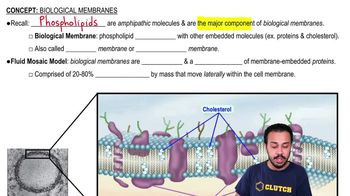
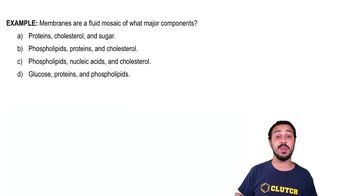
What are the major components of biological membranes?
Biological membranes are composed mainly of phospholipid bilayers with embedded proteins and cholesterol.
What does the Fluid Mosaic Model describe?
The Fluid Mosaic Model describes membranes as fluid structures with a mosaic of membrane-embedded proteins that move laterally.
What are the two main types of membrane proteins?
1) Integral membrane proteins span the bilayer. 2) Peripheral membrane proteins are attached to the membrane surface.
Name some functions of membrane proteins.
Membrane proteins function in transport, signal transduction, cell recognition, enzymatic activity, and cytoskeleton anchoring.
Define concentration gradient.
A concentration gradient is the difference in concentration of a substance between two areas.
What is diffusion?
Diffusion is the movement of molecules from an area of high concentration to low concentration without energy input.
What does selectively permeable mean in membranes?
Selectively permeable membranes allow some substances to cross while blocking others based on size, charge, or polarity.
Which molecules freely diffuse across membranes without protein facilitation?
Small, nonpolar molecules like O2 and CO2 freely diffuse across membranes.
What are the two general types of molecular transport across membranes?
1) Passive transport (no energy, down gradient). 2) Active transport (requires energy, against gradient).
What is the difference between passive and active transport?
Passive transport moves substances down their concentration gradient without energy; active transport moves substances against their gradient using energy.
What are uniporters, symporters, and antiporters?
Uniporters transport one molecule in one direction; symporters transport two molecules in the same direction; antiporters transport two molecules in opposite directions.
Define osmosis.
Osmosis is the passive diffusion of water across a semi-permeable membrane from low to high solute concentration.
What is the difference between hypotonic, isotonic, and hypertonic solutions?
Hypotonic: lower solute outside, water enters cell. Isotonic: equal solute, no net water movement. Hypertonic: higher solute outside, water leaves cell.
What happens to cells in hypotonic environments?
Cells swell as water enters; plant cells become turgid, animal cells may lyse (burst).
What is the difference between simple diffusion and facilitated diffusion?
Simple diffusion is direct movement of small uncharged molecules; facilitated diffusion requires transport proteins for charged or large molecules.
Name two types of transport proteins involved in facilitated diffusion.
1) Channels/porins form pores for molecules. 2) Carriers/transporters undergo conformational changes to move molecules.
What is primary active transport?
Primary active transport uses ATP hydrolysis to move molecules against their concentration gradient.
Describe the sodium-potassium pump.
It is an active antiporter that moves 3 Na+ ions out and 2 K+ ions into the cell using ATP.
What is secondary active transport?
Secondary active transport uses the concentration gradient established by primary active transport to move molecules without direct ATP use.
What are endocytosis and exocytosis?
Endocytosis brings large molecules into the cell via vesicles; exocytosis expels molecules out of the cell via vesicle fusion.
 Indietro
 02:21