 Indietro
Mendelian Genetics and Inheritance Principles
 01:58

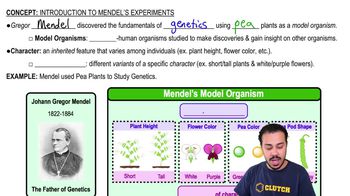
Termini in questo insieme (29)
Parental traits blend so offspring have intermediate traits, which Mendel's experiments disproved.
Traits modified by use are passed on to offspring; an early disproven hypothesis.
Used quantitative analysis of pea breeding experiments to propose genes as discrete hereditary units.
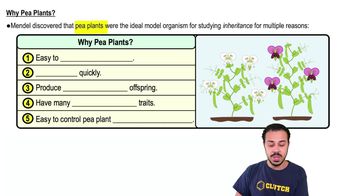
Peas are inexpensive, easy to grow, have short generation time, produce many seeds, and have polymorphic traits.
Plants that produce offspring identical to themselves when self-fertilized; homozygous for studied traits.
Cross between two pure lines differing in one trait to study inheritance patterns.
All offspring showed the dominant trait; recessive trait disappeared.
Dominant to recessive phenotype ratio is approximately 3:1.
Dominant traits appear in heterozygotes; recessive traits are masked unless homozygous.
Cross where male and female phenotypes are reversed to test if sex influences inheritance; Mendel found no effect.
Allele pairs separate during gamete formation so each gamete carries one allele.
Genotype is the genetic makeup (allele combination); phenotype is the observable trait.
Homozygous: two identical alleles; heterozygous: two different alleles for a gene.
Diagram to predict offspring genotypes and phenotypes from parental gametes.
Cross between parents heterozygous for two traits to test independent assortment.
Alleles of different genes segregate independently during gamete formation.
Cross between an individual with dominant phenotype but unknown genotype and a homozygous recessive to determine genotype.
Genes are located on chromosomes; segregation and independent assortment explained by meiosis.
Inheritance of genes located on sex chromosomes, showing different patterns in males and females.
Genes on the X chromosome; males are hemizygous and more frequently affected by recessive X-linked diseases.
Genes close on the same chromosome tend to be inherited together unless crossing over occurs, causing recombination.
More than two alleles exist for a gene in a population, e.g., ABO blood group alleles.
Dominant allele phenotype fully masks recessive allele in heterozygotes.
Both alleles in a heterozygote are fully expressed, e.g., A and B blood types.
Heterozygotes show an intermediate phenotype between the two homozygotes.
One gene masks or modifies the expression of another gene affecting the same trait.
A single gene influences multiple phenotypic traits.
Inheritance of genes located on non-sex chromosomes, following Mendelian patterns.
A trait that commonly appears in two or more distinct forms in a population.