 Indietro
Modes of Selection and Population Genetics in General Biology
 07:48

Termini in questo insieme (24)
Directional selection favors one extreme phenotype, shifting the average trait value in a population and reducing genetic variation.
Stabilizing selection favors intermediate phenotypes, reducing variation by selecting against extremes and maintaining the average trait value.
Disruptive selection favors extreme phenotypes at both ends, increasing variation and often creating a bimodal distribution.
Balancing selection maintains multiple phenotypes in a population by mechanisms like heterozygote advantage or frequency-dependent selection, preserving genetic variation.
Directional selection reduces genetic variation as alleles for the favored phenotype increase in frequency and others decline.
Stabilizing selection reduces genetic variation by decreasing the frequency of alleles producing extreme phenotypes.
Disruptive selection maintains or increases genetic variation by favoring alleles for both extremes.
Balancing selection maintains genetic variation by preserving multiple alleles or phenotypes in the population.
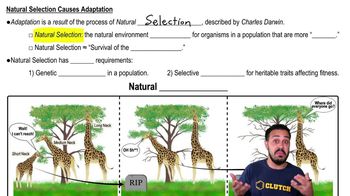
1. Variation exists in a trait.
2. Trait variation is heritable.
3. More offspring are produced than survive.
4. Survival and reproduction are non-random with respect to the trait.
The gene pool is the total collection of alleles for all genes in a population.
Random mating, no natural selection, no genetic drift, no gene flow, and no mutation.
Genotype frequencies predicted by allele frequencies: \(p^2\) for homozygous dominant, \(2pq\) for heterozygous, and \(q^2\) for homozygous recessive.
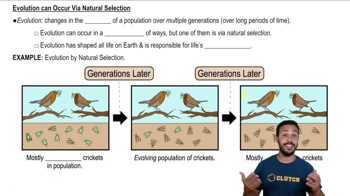
Evolution is a change in allele frequencies in a population over time.
Nonrandom mating, natural selection, genetic drift, gene flow, and mutation cause populations to evolve by changing allele frequencies.
Genetic drift is random changes in allele frequencies, especially important in small populations, often reducing genetic variation.
Gene flow is the movement of alleles between populations, which can increase or decrease genetic variation.
Mutation is the random production of new alleles, increasing genetic variation but often with fitness costs.
In sickle cell disease, heterozygotes (carrying one normal and one sickle allele) have higher fitness in malaria regions due to resistance, illustrating balancing selection.
Quantitative traits are influenced by many genes and environmental factors, showing continuous variation often with a bell-shaped distribution.
Stabilizing selection reduces extremes but random mating, Mendelian segregation, and new mutations rebuild and maintain some genetic variation.
Soapberry bugs evolved shorter beaks to feed on introduced plants with smaller fruits, showing directional selection shifting trait averages.
Bluegill males show disruptive selection: large males guard nests, small males sneak fertilizations, and intermediate males have lower fitness.
A form of balancing selection where the fitness of a phenotype depends on its frequency; rare forms have higher fitness.
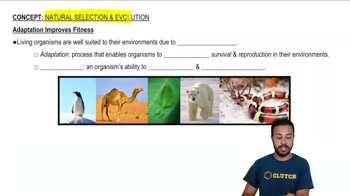
Natural selection increases average fitness by favoring alleles that improve survival and reproduction.