What is the genetic material according to early 20th-century experiments?
DNA was identified as the genetic material, not protein, based on experiments by Griffith, Avery, McCarty, MacLeod, and Hershey-Chase.
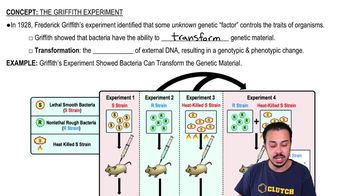
What was Frederick Griffith's experiment and its significance?
Griffith showed that a 'transforming principle' from heat-killed pathogenic bacteria could convert harmless bacteria into pathogenic ones, suggesting genetic material transfer.
What did Avery, McCarty, and MacLeod demonstrate in 1944?
They identified DNA as the transforming substance responsible for heredity, ruling out protein and RNA.
What was the Hershey-Chase experiment's key finding?
They showed that only DNA from bacteriophages enters bacterial cells during infection, confirming DNA as genetic material.
What are Chargaff's rules?
In DNA, the amount of adenine equals thymine, and guanine equals cytosine, supporting base pairing and DNA structure.
What did Rosalind Franklin contribute to DNA structure discovery?
She used X-ray crystallography to produce images showing DNA's helical structure and dimensions.
Describe the structure of DNA as proposed by Watson and Crick.
DNA is a double helix with two antiparallel sugar-phosphate backbones and nitrogenous bases paired inside (A with T, G with C).
What are the three components of a nucleotide?
A nucleotide consists of a phosphate group, a deoxyribose sugar, and a nitrogenous base.
What is the difference between purines and pyrimidines?
Purines (adenine, guanine) have a double ring structure; pyrimidines (cytosine, thymine) have a single ring.
Why do purines pair with pyrimidines in DNA?
Purine-pyrimidine pairing maintains a uniform width of the DNA double helix, consistent with X-ray data.
What type of bonds hold nitrogenous bases together in DNA?
Hydrogen bonds hold complementary bases together: A-T pairs have 2 bonds, G-C pairs have 3 bonds.
What is the significance of DNA's antiparallel strands?
The two strands run in opposite 5’ to 3’ directions, which is critical for replication and base pairing.
Where does DNA replication begin in bacteria?
Replication starts at a specific site called the origin of replication.
What is the role of helicase in DNA replication?
Helicase unwinds and separates the two DNA strands at the replication fork.
Why is primase necessary in DNA replication?
Primase synthesizes an RNA primer to provide a starting point for DNA polymerase III.
What is the difference between the leading and lagging strands?
The leading strand is synthesized continuously toward the replication fork; the lagging strand is synthesized discontinuously away from the fork in Okazaki fragments.
What are Okazaki fragments?
Short DNA fragments synthesized on the lagging strand during replication.
What is the function of DNA polymerase I?
DNA polymerase I removes RNA primers and replaces them with DNA nucleotides.
What role does DNA ligase play in replication?
DNA ligase joins Okazaki fragments by sealing the sugar-phosphate backbone.
How do DNA polymerases ensure replication accuracy?
They proofread newly synthesized DNA and correct mismatched nucleotides, reducing errors to 1 in 10 billion.
What is nucleotide excision repair?
A DNA repair mechanism where damaged DNA is cut out by nucleases and replaced by DNA polymerase and ligase.
What problem do telomeres solve in eukaryotic DNA replication?
Telomeres protect chromosome ends from shortening during replication by providing repetitive sequences.
What is the role of telomerase?
Telomerase extends telomeres in germ cells, preventing loss of important DNA sequences.
How is DNA packaged in eukaryotic cells?
DNA wraps around histone proteins forming nucleosomes, which further coil into higher-order structures to form chromatin and chromosomes.
What is heterochromatin?
Densely packed chromatin that is transcriptionally inactive and difficult to access.
How can histone modifications affect DNA packaging?
Chemical changes to histone tails can alter chromatin structure, influencing gene expression.
 Indietro
 08:56
