 Indietro
Natural Selection and Evolution Key Concepts
 07:48

Termini in questo insieme (40)
The default assumption that there is no effect or difference in a study or experiment.
The hypothesis that there is an effect or difference, opposing the null hypothesis.
The variable that is changed or controlled in an experiment to test its effects.
The variable being tested and measured in an experiment.
A group in an experiment where a known response is expected, ensuring the experiment works.
A group where no response is expected, used to identify confounding factors.
Non-numerical data describing qualities or characteristics.
Numerical data that can be measured and quantified.
A statistical test to determine if observed data differ from expected data, using degrees of freedom and critical values.
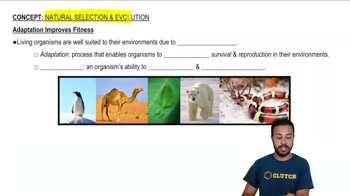
A trait that increases an organism's chance of survival and reproduction in its environment.
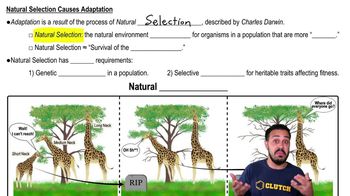
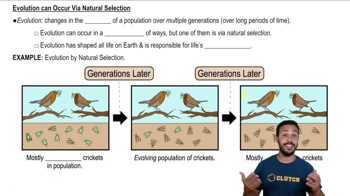
The process where organisms better adapted to their environment tend to survive and produce more offspring.
The intentional breeding of organisms to produce desired traits.
The variety of different species or genetic variations within a population or ecosystem.
Similarity in structure due to shared ancestry, including homologous structures and molecular homology.
A structure that has lost most or all of its original function through evolution.
The study of the development of embryos, showing evolutionary relationships.
The process where unrelated species evolve similar traits independently.
Structures with similar function but different evolutionary origins.
The preserved remains or traces of ancient organisms used to study evolution.
The study of the geographic distribution of species and ecosystems.
An allele that is masked by a dominant allele and only expressed in homozygous form.
An allele that expresses its trait even when only one copy is present.
A unit of heredity made up of DNA that codes for a specific trait.
A structure of DNA and protein that contains genes.
Having two identical alleles for a particular gene.
Having two different alleles for a particular gene.
The observable physical or biochemical characteristics of an organism.
The genetic makeup of an organism, consisting of its alleles.
A group of individuals of the same species living in the same area.
All the genes and their alleles present in a population.
An equation used to calculate allele frequencies in a population: \(p^2 + 2pq + q^2 = 1\)
Genetic Drift
A process in which chance events cause unpredictable fluctuations in allele frequencies from one generation to the next. Effects of genetic drift are most pronounced in small populations.
Founder effect
Genetic drift that occurs when a few individuals become isolated from a larger population and form a new population whose gene pool composition is not reflective of that of the original population
Bottleneck effect
Genetic drift that occurs when the size of a population is reduced, as by a natural disaster or human actions. Typically, the surviving population is no longer genetically representative of the original population.
Gene flow
The transfer of alleles from one population to another, resulting from the movement of fertile individuals or their gametes.
Relative fitness
The contribution an individual makes to the gene pool of the next generation, relative to the contributions of other individuals in the population.
Disruptive selection
Natural selection in which individuals on both extremes of a phenotypic range survive or reproduce more successfully than do individuals with intermediate phenotypes.
Balancing selection
Natural selection that maintains two or more phenotypic forms in a population.
Directional selection
Natural selection in which individuals at one end of the phenotypic range survive or reproduce more successfully than do other individuals.
Stabilizing selection
Natural selection in which intermediate phenotypes survive or reproduce more successfully than do extreme phenotypes.