 Indietro
oct 2
 01:05

Termini in questo insieme (24)
A gene is the unit of inheritance that determines the amino acid sequence of a polypeptide.
DNA stores genetic information; RNA assembles polypeptides according to DNA instructions.
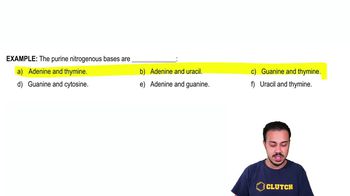
DNA bases: adenine (A), thymine (T), guanine (G), cytosine (C). RNA bases: A, guanine (G), cytosine (C), uracil (U).
Nucleotides : monomers that make up nucleic acids consist of a 5-carbon sugar (deoxyribose in DNA, ribose in RNA), a phosphate group, and a nitrogenous base which is a structure that contains nitrogen and carbon .
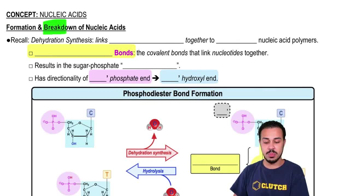
Nucleotides are joined by dehydration reactions forming a sugar-phosphate backbone with nitrogenous bases extending outward.
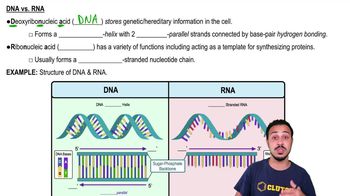
DNA is composed of two polynucleotide strands forming a double helix with complementary base pairing: A pairs with T, G pairs with C.
In DNA, adenine pairs with thymine (A-T) and guanine pairs with cytosine (G-C) via hydrogen bonds, making strands complementary.
DNA is the genetic material inherited from parents, arranged in chromosomes carrying many genes, and directs its own replication.
Gene expression is the process of producing proteins using instructions encoded in DNA, involving transcription and translation.
What happens during gene expression
• A gene first directs the synthesis of an RNA molecule •
The RNA molecule interacts with the protein-building machinery of the cell• Nucleic acid language is translated into protein language •
Organism’s genes determine the protein and the structures and functions of its body
Lactose tolerance is an example of convergent evolution, where similar adaptations evolve independently in different lineages.
Energy is the capacity to cause change or do work, existing as kinetic, thermal, light, potential, or chemical energy.
Energy can be transferred or transformed but cannot be created or destroyed; some energy becomes unavailable as entropy (disorder or randomness)
Every energy conversion increases entropy, meaning disorder or randomness in the system.
Exergonic reactions release energy; endergonic reactions require an input of energy.
Metabolism is the total of an organism's chemical reactions, including both exergonic and endergonic reactions.
A metabolic pathway is a series of chemical reactions that build or break down complex molecules into simpler compounds.
Use of energy released from exergonic reactions to drive endergonic reactions
Adenosine triphosphate (ATP) is the main energy-carrying molecule in cells due to its negatively charged phosphate groups.
ATP hydrolysis breaks bonds between phosphate groups, releasing energy and producing ADP and a phosphate group.
The phosphate group broken off of ATP is transferred to another molecule
ATP powers chemical work, transport work, and mechanical work in cells.
Hydrolysis of ATP releases energy that drives endergonic reactions•
Product is an ADP molecule that can pick up another phosphate group to become ATP•
Very fast cycle•
A muscle cell consumes and regenerates 10 million ATP/sec
what is thermodynamics
Study of energy transfor-mations that occur in a collection of matter