 Indietro
oct9
 06:35

Termini in questo insieme (22)
Cell theory states that all living things are composed of cells and all cells come from other cells.
Robert Hooke (1665) was the first person to look at a plant through a microscope and coined the term cellulae meaning tiny compartments.
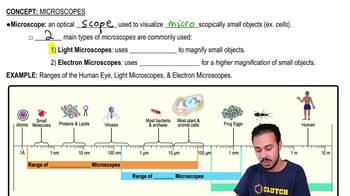
Light microscopes use visible light and glass lenses including the objective lens and ocular lens to magnify images.
Magnification increases image size; resolution measures image clarity and the ability to distinguish two objects as separate.
Light microscopes have a resolution limit of about 0.2 μm and cannot improve beyond ~1000X magnification.
Electron microscopes use electron beams and electromagnets to magnify images with 100-fold better resolution than light microscopes but cannot view live samples.
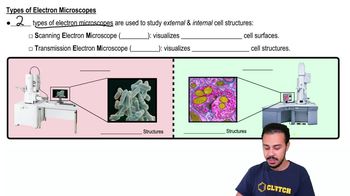
SEM studies cell surface architecture by coating samples with gold and producing 3D images from scattered electrons.
TEM passes electrons through thin specimen sections stained with heavy metals to produce detailed internal cell images.
Smaller cells have a higher surface area to volume ratio, which is important for efficient exchange with the environment.
The plasma membrane forms a flexible boundary between the cell and its surroundings, allowing selective passage of substances.
The first cells evolved and lived for about 1.5 billion years before eukaryotic cells evolved
Bacteria and archaea
Small, simple cell structure
The nucleoid is the region where the prokaryotic chromosome is coiled, not enclosed by a membrane.
The cell wall protects and maintains shape; the capsule is a sticky outer coat that helps cells adhere to surfaces.
Flagella are long projections that propel prokaryotic cells through their environment; not all prokaryotes have them.
Eukaryotic cells are larger, more complex, and have membrane-enclosed organelles and a nucleus housing DNA.
Organelles perform specific tasks: nucleus and ribosomes for genetic control; ER, Golgi, lysosomes for molecule processing; mitochondria and chloroplasts for energy; cytoskeleton and membrane for structure.
Cellular metabolism refers to the chemical activities within a cell, optimized by organelles maintaining specific internal conditions.
Animal cells have lysosomes, centrosomes, and sometimes flagella and cilia, which are rare in plant cells.
Plant cells have a rigid cellulose cell wall, plasmodesmata for cell communication, chloroplasts for photosynthesis, and a large central vacuole.
The cytoskeleton includes microtubules, microfilaments, and intermediate filaments that provide structural support and enable movement.
electron microscopy
Cannot be used to look at live samples
light microscopy
Many parts of a cell and some full microorganisms are too small to be seen with a light microscope