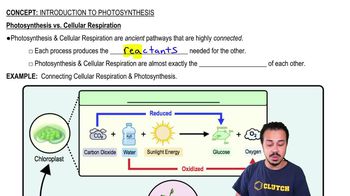
The process by which plants, algae, and some prokaryotes convert light energy into chemical energy stored in sugars, using CO₂ and water and releasing O₂.
Autotroph
An organism that makes its own organic molecules from inorganic sources such as CO₂ and H₂O, without consuming other organisms; the producers of the biosphere.
Photoautotroph
An autotroph that uses light energy to make organic compounds (e.g., plants, algae, cyanobacteria).
Heterotroph
An organism that cannot make its own food and must obtain organic molecules by consuming other organisms or their products; the consumers of the biosphere.
Chloroplast
The organelle in plants and algae that is the site of photosynthesis; enclosed by a double membrane and contains chlorophyll.
Stomata
Microscopic pores on the leaf surface through which CO₂ enters and O₂ exits the leaf.
Chlorophyll
The green pigment in thylakoid membranes that absorbs light energy to drive the synthesis of organic molecules.
Thylakoid
A flattened membranous sac inside a chloroplast; its membrane contains chlorophyll-bearing photosystems and electron transport chain components.
Summary equation for photosynthesis
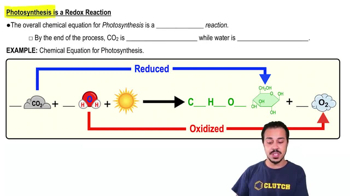
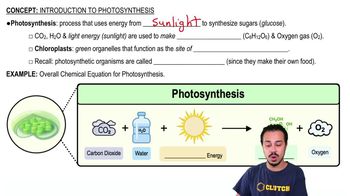
6 CO₂ + 12 H₂O + light energy → C₆H₁₂O₆ + 6 O₂ + 6 H₂O; often simplified to 6 CO₂ + 6 H₂O + light energy → C₆H₁₂O₆ + 6 O₂.
Redox reactions in photosynthesis
Water is oxidized (loses electrons, releasing O₂) and CO₂ is reduced (gains electrons and H) to form sugar; light energy boosts electrons to a higher energy level.
Light reactions
The first stage of photosynthesis in thylakoid membranes; water is split, O₂ released, and ATP and NADPH produced.
Calvin cycle
The second stage of photosynthesis in the stroma; uses ATP and NADPH to reduce CO₂ to sugar.
NADP⁺ / NADPH
An electron carrier; NADP⁺ is reduced to NADPH by light reactions, and NADPH provides electrons for the Calvin cycle.
Photon
A fixed quantity of light energy; a discrete packet of light with energy inversely related to its wavelength.
Photosystem II (PS II)
The photosystem that functions first in light reactions; its reaction-center chlorophyll a (P680) absorbs best at 680 nm and splits water.
Photosystem I (PS I)
The photosystem whose reaction-center chlorophyll a (P700) absorbs best at 700 nm; reduces NADP⁺ to NADPH.
Linear electron flow
Electron flow from water to PS II, through electron transport chain to PS I, and finally to NADP⁺; produces ATP, NADPH, and O₂.
Cyclic electron flow
Electrons from PS I cycle back to the electron transport chain instead of NADP⁺; produces ATP but no NADPH or O₂.
Chemiosmosis in chloroplasts
H⁺ pumped into thylakoid space by electron transport chain; proton-motive force drives H⁺ back through ATP synthase to make ATP.
Carbon fixation
The incorporation of carbon from CO₂ into an organic molecule; the first phase of the Calvin cycle.
Rubisco
The enzyme that catalyzes the first step of carbon fixation, attaching CO₂ to RuBP; the most abundant protein in chloroplasts.
3-Phosphoglycerate
The three-carbon compound formed when the unstable six-carbon intermediate splits after carbon fixation.
Phase 2: reduction (Calvin cycle)
Each 3-phosphoglycerate receives a phosphate from ATP and is reduced by NADPH electrons, forming glyceraldehyde 3-phosphate (G3P).
Glyceraldehyde 3-phosphate (G3P)
The three-carbon sugar that is the direct product of the Calvin cycle; used to build glucose and other organic compounds.
Role of ATP in the Calvin cycle
Provides energy (phosphate groups) for the reduction phase and for regenerating RuBP.
Role of NADPH in the Calvin cycle
Provides high-energy electrons that reduce 3-phosphoglycerate to G3P.
Calvin cycle totals
To make one G3P, the cycle uses 3 CO₂, 9 ATP, and 6 NADPH; ATP and NADPH are regenerated by light reactions.
 Indietro
 03:32