Skip to main content
General Biology
Il mio corso
Impara
Preparazione agli esami
AI Tutor
Guide di studio
Soluzioni per libri di testo
Flashcard
Esplora
Prova l'app
Il mio corso
Impara
Preparazione agli esami
AI Tutor
Guide di studio
Soluzioni per libri di testo
Flashcard
Esplora
Prova l'app
Indietro
Photosynthesis and Chloroplast Structure in General Biology
Puoi toccare per girare la carta.
What is photosynthesis?
Puoi toccare per girare la carta.
👆
What is photosynthesis?
Photosynthesis is the process that converts solar energy into chemical energy, producing oxygen and organic molecules like glucose.
Avanzamenti del tracciato
I pulsanti di controllo sono stati cambiati in modalità "navigazione".
1/16
Video consigliati
03:32
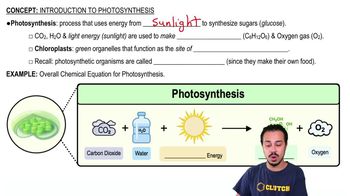
Introduction to Photosynthesis
21140
views
425
rank
07:55
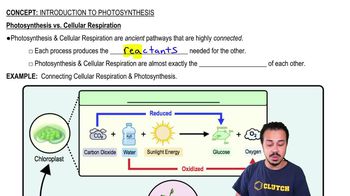
Photosynthesis vs. Cellular Respiration
16845
views
220
rank
03:20
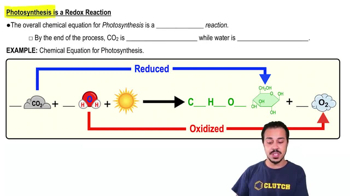
Photosynthesis is a Redox Reaction
1914
views
45
rank
Termini in questo insieme (16)
Nascondere definizioni
What is photosynthesis?
Photosynthesis is the process that converts solar energy into chemical energy, producing oxygen and organic molecules like glucose.
Write the overall photosynthesis chemical equation.
6CO\(_2\) + 6H\(_2\)O + light energy = C\(_6\)H\(_{12}\)O\(_6\) + 6O\(_2\)
Where in the plant does photosynthesis mainly occur?
Photosynthesis mainly occurs in the leaves, specifically in the mesophyll cells.
What are stomata and their function?
Stomata are openings in the leaf that allow CO\(_2\) to enter and O\(_2\) to exit.
Where in the cell does photosynthesis take place?
Photosynthesis takes place in chloroplasts, which are found in the mesophyll of leaves.
Describe the structure of a chloroplast relevant to photosynthesis.
Chloroplasts contain stacks called granum made of thylakoid sacs holding chlorophyll; the fluid inside is called stroma.
What role do chloroplasts play in photosynthesis?
Chloroplasts split water into hydrogen and oxygen, incorporate hydrogen electrons into sugar, and release oxygen as a by-product.
What are the two main stages of photosynthesis?
The two stages are the light-dependent reactions (photo) and the light-independent reactions (Calvin Cycle or synthesis).
Where do the light-dependent reactions occur and what happens?
They occur in the thylakoid membrane, split water, release oxygen, and generate ATP and NADPH.
Where does the Calvin Cycle occur and what does it do?
It occurs in the stroma, uses ATP and NADPH, and forms sugar from CO\(_2\).
What is a photosystem?
A photosystem is a protein-pigment complex in the thylakoid membrane that harvests light energy.
How many photosystems are involved in photosynthesis and which comes first?
There are two photosystems: Photosystem II comes first, followed by Photosystem I.
What wavelengths do Photosystem II and Photosystem I best absorb?
Photosystem II absorbs best at 680 nm, and Photosystem I absorbs best at 700 nm.
Name the components embedded in the thylakoid membrane photosystem.
Light-harvesting complexes, reaction center complex, primary electron acceptor, and a special pair of chlorophyll a molecules.
What is the function of the primary electron acceptor in a photosystem?
It accepts excited electrons from the reaction center and becomes reduced.
What pigment gives leaves their green color?
Chlorophyll, located in the thylakoid membranes, gives leaves their green color.
 IndietroIndietro
 03:32