 Indietro
Photosynthesis and Photorespiration in C3, C4, and CAM Plants
 14:32

Termini in questo insieme (16)
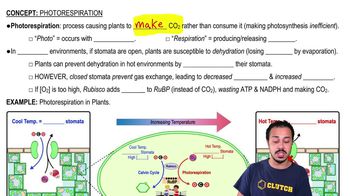
Photorespiration is a process that wastes energy by consuming O2 and organic fuels, releasing CO2 without producing sugar. It slows down photosynthesis and reduces plant efficiency.
Photorespiration helps plants avoid overheating by wasting energy on purpose when stomata close, protecting the plant under stress.
C3 plants produce a 3-carbon molecule as the first stable product of the Calvin cycle, have both light and dark reactions in the same mesophyll cell, and are most susceptible to photorespiration.
C3 plants perform one carbon fixation round per cycle.
C4 plants better avoid photorespiration by separating light and dark reactions into different cells and producing a 4-carbon intermediate.
Light reactions occur in mesophyll cells, and dark reactions occur in bundle sheath cells.
C4 plants perform two carbon fixation rounds.
The 4-carbon intermediate supplies additional CO2 to the Calvin cycle when stomata close and CO2 levels are low, reducing photorespiration.
CAM plants separate carbon fixation rounds in time, opening stomata at night to fix CO2 and closing them during the day to reduce water loss and photorespiration.
Both light and dark reactions occur in the same cell in CAM plants.
CAM plants perform two carbon fixation rounds separated by time (night and day).
CAM plants open stomata at night when temperatures are cooler to fix CO2 and minimize water loss.
Rubisco produces a two-carbon compound, consumes O2 and organic fuels, releases CO2, and wastes energy without producing sugar or heat.
Because both light and dark reactions occur in the same mesophyll cell and they do not have mechanisms to concentrate CO2, leading to more rubisco oxygenation.
Spatial separation of reactions into mesophyll and bundle sheath cells allows C4 plants to concentrate CO2 and reduce photorespiration.
Temporal separation allows CAM plants to fix CO2 at night and perform the Calvin cycle during the day, conserving water and reducing photorespiration.