Skip to main content
General Biology
Il mio corso
Impara
Preparazione agli esami
AI Tutor
Guide di studio
Soluzioni per libri di testo
Flashcard
Esplora
Prova l'app
Il mio corso
Impara
Preparazione agli esami
AI Tutor
Guide di studio
Soluzioni per libri di testo
Flashcard
Esplora
Prova l'app
Indietro
Photosynthesis and Related Concepts - Chapter 10 Main Ideas
Puoi toccare per girare la carta.
What is the main difference between Photosystem I and Photosystem II?
Puoi toccare per girare la carta.
👆
What is the main difference between Photosystem I and Photosystem II?
Photosystem II
absorbs light first and splits water to release oxygen, while
Photosystem I
absorbs light later and helps produce NADPH.
Avanzamenti del tracciato
I pulsanti di controllo sono stati cambiati in modalità "navigazione".
1/19
Video consigliati
03:32
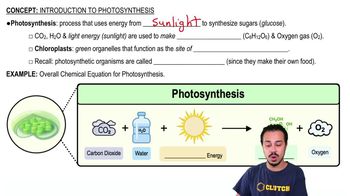
Introduction to Photosynthesis
21140
views
425
rank
07:55
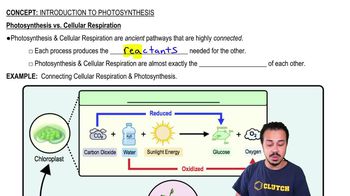
Photosynthesis vs. Cellular Respiration
16845
views
220
rank
03:20
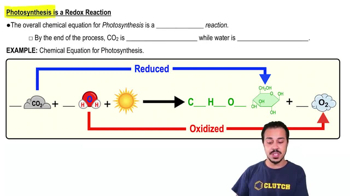
Photosynthesis is a Redox Reaction
1914
views
45
rank
Termini in questo insieme (19)
Nascondere definizioni
What is the main difference between Photosystem I and Photosystem II?
Photosystem II
absorbs light first and splits water to release oxygen, while
Photosystem I
absorbs light later and helps produce NADPH.
What is the Enhancement Effect in photosynthesis?
The
Enhancement Effect
is the increased rate of photosynthesis when both Photosystem I and II work together compared to individually.
What is Cyclical Photosynthesis?
A process where electrons cycle back to Photosystem I to produce ATP without producing NADPH or oxygen.
What is Ribulose BiPhosphate (RuBP)?
RuBP
is a 5-carbon sugar that combines with CO2 in the Calvin cycle to start carbon fixation.
What role does Rubisco play in photosynthesis?
Rubisco
is the enzyme that catalyzes the fixation of CO2 to RuBP in the Calvin cycle.
What is PEP Carboxylase and its function?
PEP Carboxylase
is an enzyme in C4 and CAM plants that fixes CO2 into a 4-carbon compound, helping reduce photorespiration.
What is the Photorespiration Problem?
Photorespiration occurs when Rubisco fixes O2 instead of CO2, wasting energy and reducing photosynthesis efficiency.
What are Stoma and Guard Cells?
Stoma
are pores on leaves for gas exchange, controlled by
Guard Cells
that open or close them.
How do C3, C4, and CAM plants differ?
C3 plants fix CO2 directly via Rubisco; C4 plants use PEP Carboxylase to reduce photorespiration; CAM plants fix CO2 at night to conserve water.
What goes into the Light Dependent Reaction?
Light energy, water (H2O), and ADP + NADP+ enter the Light Dependent Reaction.
What comes out of the Light Dependent Reaction?
Oxygen (O2), ATP, and NADPH are produced in the Light Dependent Reaction.
Is energy required in the Light Dependent Reaction? If so, where does it come from?
Yes, energy is required and it comes from light absorbed by chlorophyll.
Is energy released in the Light Dependent Reaction? If so, where does it go?
Energy is stored in ATP and NADPH molecules for use in the Light Independent Reaction.
Where does the Light Dependent Reaction take place?
It takes place in the thylakoid membranes of the chloroplast.
What goes into the Light Independent Reaction (Calvin Cycle)?
CO2, ATP, and NADPH enter the Light Independent Reaction.
What comes out of the Light Independent Reaction?
Glucose (or other sugars), ADP, and NADP+ are produced.
Is energy required in the Light Independent Reaction? If so, where does it come from?
Yes, energy is required and it comes from ATP and NADPH produced in the Light Dependent Reaction.
Is energy released in the Light Independent Reaction? If so, where does it go?
Energy is stored in the chemical bonds of glucose.
Where does the Light Independent Reaction take place?
It occurs in the stroma of the chloroplast.
 IndietroIndietro
 03:32