 Indietro
Photosynthesis and Related Concepts - General Biology
 03:32

Termini in questo insieme (32)
The 10% rule states that only about 10% of the energy from one trophic level is transferred to the next level.
Autotrophs are organisms that produce their own food using light or chemical energy.
Photoautotrophs use light energy to synthesize organic compounds from CO2.
Heterotrophs obtain energy by consuming organic molecules made by other organisms.
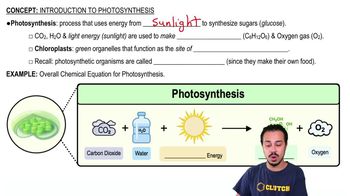
Photosynthesis is the process by which photoautotrophs convert light energy into chemical energy stored in glucose.
A chloroplast is an organelle in plant cells where photosynthesis occurs.
The mesophyll is the inner tissue of a leaf where most chloroplasts are found and photosynthesis takes place.
Stomata are pores on the leaf surface that allow gas exchange (CO2 in, O2 out).
Stroma is the fluid-filled space surrounding thylakoids where the Calvin cycle occurs.
Thylakoids are membrane-bound sacs inside chloroplasts where light reactions happen; the thylakoid membrane contains chlorophyll.
A granum is a stack of thylakoids within the chloroplast.
Chlorophyll is the green pigment that absorbs light energy for photosynthesis.
Pigments are molecules that absorb specific wavelengths of light to capture energy.
Electromagnetic radiation is energy that travels in waves, including visible light used in photosynthesis.
Visible light is the portion of the electromagnetic spectrum detectable by the human eye, used by plants for photosynthesis.
Wavelength is the distance between crests of electromagnetic waves, determining light color.
Absorbance is the uptake of light energy by pigments during photosynthesis.
Light reactions occur in thylakoid membranes, converting light energy to ATP and NADPH.
The Calvin cycle uses ATP and NADPH to fix CO2 into organic molecules; also called dark or light-independent reactions.
Photons are particles of light that carry energy absorbed by pigments.
Fluorescence is the release of light by a pigment after absorbing photons.
A photosystem is a protein-pigment complex that captures light energy for photosynthesis.
The reaction center is the chlorophyll-containing part of a photosystem where light energy is converted to chemical energy.
The light harvesting complex contains pigments that capture and funnel light energy to the reaction center.
The special pair is a pair of chlorophyll molecules in the reaction center that transfer excited electrons.
Electrons flow from photosystem II to photosystem I via the electron transport chain, producing ATP and NADPH.
Linear electron flow is the movement of electrons from water to NADP+ producing ATP and NADPH.
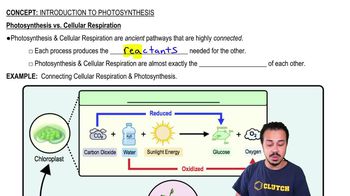
Both generate ATP via electron transport and chemiosmosis; mitochondria use food-derived electrons, chloroplasts use light-excited electrons.
Rubisco is the enzyme that fixes CO2 to ribulose bisphosphate in the Calvin cycle.
G3P is a 3-carbon sugar produced in the Calvin cycle, used to form glucose and other carbohydrates.
The three phases are carbon fixation, reduction, and regeneration of ribulose bisphosphate.
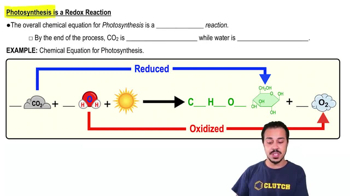
A redox reaction involves the transfer of electrons; oxidation is loss, reduction is gain of electrons.