 Indietro
Photosynthesis - General Biology
 03:32

Termini in questo insieme (21)
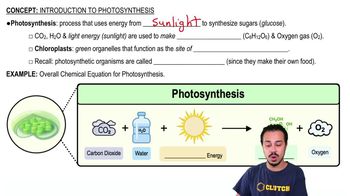
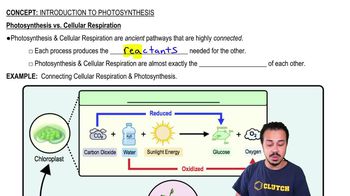
Photosynthesis is the process by which autotrophs use sunlight to manufacture carbohydrates from carbon dioxide and water, producing oxygen as a by-product.
Autotrophs make their own food via photosynthesis. Heterotrophs must obtain sugars from other organisms.
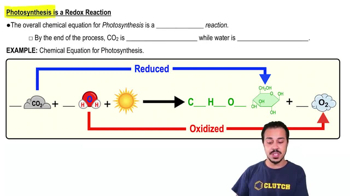
6CO2 + 6H2O + light energy → C6H12O6 + 6O2
1. Light-capturing reactions produce O2 from H2O and generate ATP and NADPH.
2. Calvin cycle uses ATP and NADPH to reduce CO2 to sugar.
Photosynthesis occurs in chloroplasts, which have outer and inner membranes, thylakoids stacked into grana, and a fluid-filled stroma.
Pigments absorb specific wavelengths of light to capture energy. Chlorophylls absorb red and blue light and reflect green, while carotenoids absorb blue and green and reflect yellow, orange, or red.
Visible light, part of the electromagnetic spectrum, contains photons with energy inversely proportional to wavelength; shorter wavelengths have more energy to drive photosynthesis.
Chlorophyll has a head with a magnesium atom in a ring structure that absorbs light, and a long isoprenoid tail anchoring it to the thylakoid membrane.
Accessory pigments absorb light and transfer energy to chlorophyll, extend the range of light wavelengths absorbed, and protect chlorophyll from damage by stabilizing free radicals.
A photosystem is a complex of 200–300 chlorophyll and accessory pigment molecules in the thylakoid membrane that capture light energy and transfer it to a reaction center.
Light excites electrons in Photosystem II, which are transferred to pheophytin, then down an electron transport chain, producing a proton-motive force used to make ATP. Water is split to replace lost electrons, releasing O2.
Electrons from Photosystem II are re-excited in Photosystem I and passed to ferredoxin, then to NADP+ reductase, which reduces NADP+ to NADPH in the stroma.
The Z scheme describes the linear flow of electrons from water through Photosystem II and I, producing ATP and NADPH.
Cyclic electron flow recycles electrons from Photosystem I back to the electron transport chain, producing additional ATP without making NADPH.
CO2 enters through pores called stomata, which are openings controlled by guard cells on the leaf surface.
Carbon fixation is the addition of CO2 to ribulose bisphosphate (RuBP) by the enzyme Rubisco, producing two molecules of 3-phosphoglycerate (3PGA).
1. Fixation: CO2 added to RuBP.
2. Reduction: 3PGA is phosphorylated and reduced to G3P.
3. Regeneration: ATP regenerates RuBP to continue the cycle.
G3P is used to synthesize glucose and fructose, which can be combined into sucrose or polymerized into starch for storage.
Photorespiration occurs when Rubisco adds O2 instead of CO2 to RuBP, consuming oxygen and releasing CO2, which reduces photosynthetic efficiency.
C4 plants fix CO2 first into a 4-carbon compound in mesophyll cells using PEP carboxylase, then transport it to bundle sheath cells where CO2 is released for the Calvin cycle, reducing O2 interference.
CAM plants fix CO2 at night into 4-carbon acids stored in vacuoles, then release CO2 during the day for the Calvin cycle, temporally separating carbon fixation and sugar production.