Skip to main content
General Biology
Il mio corso
Impara
Preparazione agli esami
AI Tutor
Guide di studio
Soluzioni per libri di testo
Flashcard
Esplora
Prova l'app
Il mio corso
Impara
Preparazione agli esami
AI Tutor
Guide di studio
Soluzioni per libri di testo
Flashcard
Esplora
Prova l'app
Indietro
Photosynthesis: Light Reactions and Calvin Cycle
Puoi toccare per girare la carta.
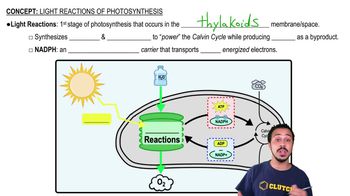
Where do the light reactions of photosynthesis occur?
Puoi toccare per girare la carta.
👆
Where do the light reactions of photosynthesis occur?
In the
thylakoid membrane
of the chloroplast.
Avanzamenti del tracciato
I pulsanti di controllo sono stati cambiati in modalità "navigazione".
1/14
Video consigliati
01:48
Light Reactions of Photosynthesis Example 1
12679
views
152
rank
04:06
Light Reactions of Photosynthesis
16880
views
206
rank
15:15
Steps of the Light Reactions
16569
views
202
rank
Termini in questo insieme (14)
Nascondere definizioni
Where do the light reactions of photosynthesis occur?
In the
thylakoid membrane
of the chloroplast.
What are the main inputs and outputs of the light reactions?
Inputs:
Light energy
and
H₂O
. Outputs:
ATP
,
NADPH
, and
O₂
(by-product).
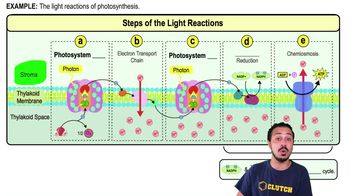
What is the role of Photosystem II in the light reactions?
Photosystem II absorbs light, energizes electrons, and splits water to replace electrons, releasing
O₂
and
H⁺
.
What happens to electrons after Photosystem II?
Electrons pass down an
electron transport chain
, pumping H⁺ into the thylakoid space.
What is the function of Photosystem I?
Photosystem I re-energizes electrons before they reduce NADP⁺ to
NADPH
.
How is ATP produced in the light reactions?
H⁺ ions flow back through
ATP synthase
via chemiosmosis, producing
ATP
.
Where does the Calvin cycle take place?
In the
stroma
of the chloroplast.
What is the first step of the Calvin cycle?
Carbon fixation:
Rubisco
attaches CO₂ to RuBP, forming two 3-carbon 3-PGA molecules.
What happens during the reduction phase of the Calvin cycle?
ATP and NADPH convert 3-PGA into
G3P
, a 3-carbon sugar.
What is the regeneration step in the Calvin cycle?
Most G3P is rearranged using ATP to regenerate RuBP, allowing the cycle to continue.
How many G3P molecules are produced from 3 CO₂ molecules in the Calvin cycle?
6 G3P molecules are produced; 1 G3P exits to make sugars, and 5 regenerate RuBP.
What sugars are produced from G3P?
G3P is converted into
glucose
,
sucrose
, and
starch
.
What is the relationship between light reactions and the Calvin cycle?
Light reactions produce ATP and NADPH that power the Calvin cycle; the Calvin cycle uses chemical energy to build sugars.
What is the overall chemical equation for photosynthesis?
6 CO₂ + 6 H₂O + light energy → C₆H₁₂O₆ + 6 O₂.
 IndietroIndietro
 01:48