Skip to main content
General Biology
Il mio corso
Impara
Preparazione agli esami
AI Tutor
Guide di studio
Soluzioni per libri di testo
Flashcard
Esplora
Prova l'app
Il mio corso
Impara
Preparazione agli esami
AI Tutor
Guide di studio
Soluzioni per libri di testo
Flashcard
Esplora
Prova l'app
Indietro
Plant Diversity and Life Cycles in General Biology
Puoi toccare per girare la carta.
Origin of land plants
Puoi toccare per girare la carta.
👆
Origin of land plants
Land plants originated from green algae about 470 million years ago (mya).
Avanzamenti del tracciato
I pulsanti di controllo sono stati cambiati in modalità "navigazione".
1/26
Video consigliati
06:17
Land Plants - 4
4246
views
54
rank
12:57
Land Plants - 2
5585
views
78
rank
2
comments
03:36
Land Plants - 3
4754
views
23
rank
Termini in questo insieme (26)
Nascondere definizioni
Origin of land plants
Land plants originated from green algae about 470 million years ago (mya).
Major plant groups
Bryophytes (mosses, liverworts, hornworts), seedless vascular plants (ferns), and seed plants (gymnosperms and angiosperms).
Alternation of generations in plants
Plants alternate between multicellular haploid gametophyte and diploid sporophyte stages.
Dominant stage in bryophytes
The gametophyte stage is dominant in bryophytes (non-vascular plants).
Dominant stage in seedless vascular plants
The sporophyte stage is dominant in seedless vascular plants like ferns.
Two types of vascular tissue
Xylem
transports water and minerals;
phloem
transports sugars and organic nutrients.
Functions of roots and leaves
Roots anchor plants and absorb water and nutrients; leaves increase surface area for photosynthesis.
Sporophylls
Leaves that bear sporangia, the structures producing spores.
Homosporous spore production
Most seedless vascular plants produce one type of spore that develops into a bisexual gametophyte.
Heterosporous spore production
All seed plants and some seedless vascular plants produce two types of spores: megaspores (female) and microspores (male).
Phylum Lycophyta
Includes club mosses, spike mosses, and quillworts; small herbaceous plants with vascular tissue.
Phylum Monilophyta
Includes ferns, horsetails, and whisk ferns; most widespread seedless vascular plants.
Significance of seedless vascular plants
They formed major forests in the Devonian and Carboniferous, contributing to coal deposits and global cooling.
Seed plant origin and importance
Seed plants originated about 360 mya and became dominant terrestrial producers due to seed adaptations.
Components of a seed
A seed contains an embryo, a food supply, and a protective seed coat.
Four key seed plant traits
Reduced gametophytes, heterospory, ovules, and pollen.
Reduced gametophytes in seed plants
Gametophytes are microscopic and dependent on the sporophyte for nutrition.
Ovule structure
An ovule consists of a megaspore within a megasporangium, surrounded by protective integuments.
Pollen and its function
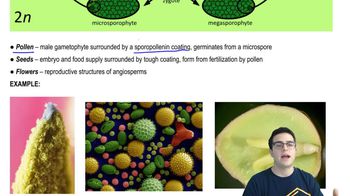
Microspores develop into pollen grains, which are male gametophytes enclosed in a pollen wall, enabling dispersal.
Pollination process
Transfer of pollen to the ovule-containing part of a seed plant, leading to fertilization by sperm from the pollen tube.
Evolutionary advantages of seeds
Seeds can remain viable longer, disperse farther, and contain stored energy to support early growth.
Gymnosperms
Seed plants with 'naked seeds' exposed on cones; includes conifers, cycads, ginkgo, and gnetophytes.
Angiosperm key adaptations
Flowers and fruits; flowers facilitate pollination, fruits protect seeds and aid dispersal.
Flower structure
Composed of sepals, petals (attract pollinators), stamens (produce pollen), and carpels (produce ovules).
Human dependence on seed plants
Seed plants provide food, construction materials, fuel, and medicine.
Threats to plant diversity
Habitat destruction causes extinction of many plant species and associated animal species.
 IndietroIndietro
 06:17