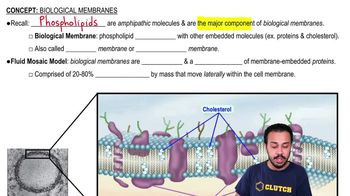
The bilayer has hydrophilic heads facing outward and hydrophobic tails facing inward.
Role of cholesterol in the plasma membrane
Cholesterol modulates membrane fluidity, maintaining membrane stability and flexibility.
Function of glycoproteins and glycolipids
They are involved in cell recognition and signaling on the membrane surface.
Anchoring proteins in the membrane
Anchoring proteins attach the membrane to the cytoskeleton or extracellular matrix.
Identifier proteins in the membrane
Identifier proteins serve as cell recognition markers.
Enzymatic proteins in the membrane
Enzymes embedded in the membrane catalyze chemical reactions at the cell surface.
Receptor proteins function
Receptors bind signaling molecules to transmit signals into the cell.
Carrier proteins role
Carrier proteins transport specific substances across the membrane.
Channel proteins function
Channels allow passive movement of ions or molecules through the membrane.
Signaling proteins in the membrane
Signaling proteins transmit information into the cell to trigger cellular responses.
Plasma membrane composition
The plasma membrane is a selectively permeable barrier made of a phospholipid bilayer with embedded proteins, cholesterol, glycoproteins, and glycolipids.
Function of the plasma membrane
It separates the cell from its environment and regulates substance movement in and out of the cell.
Fluid-mosaic model description
Describes the membrane as a dynamic structure with proteins and lipids moving laterally, allowing flexibility and specialized domains.
 Indietro
 02:21