 Indietro
Properties and Characteristics of the Four Biomolecules
 01:17
01:17
Termini in questo insieme (20)
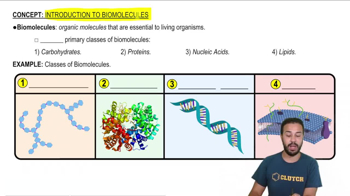
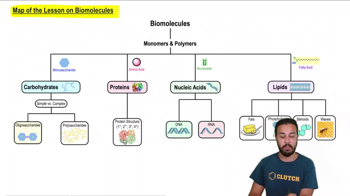
The four main types of biomolecules are carbohydrates, lipids, proteins, and nucleic acids.
Carbohydrates primarily provide energy and serve as structural components in cells.
The monomers of carbohydrates are called monosaccharides, such as glucose.
Lipids are hydrophobic molecules mainly used for long-term energy storage and making up cell membranes.
Phospholipids are a common lipid type that form the cell membrane bilayer.
Proteins are polymers made of amino acids linked by peptide bonds.
Proteins function as enzymes, structural components, transport molecules, and in cell signaling.
A protein's function is determined by its unique 3D structure formed by amino acid sequence.
Nucleic acids are polymers of nucleotides, which include a sugar, phosphate group, and nitrogenous base.
DNA stores genetic information, and RNA helps in protein synthesis.
Phosphodiester bonds link nucleotides in nucleic acid chains.
Carbohydrates have a ring structure with carbon, hydrogen, and oxygen, while lipids have long hydrocarbon chains or rings and are hydrophobic.
Enzymes are proteins that act as biological catalysts to speed up chemical reactions.
Phospholipids are the main biomolecules forming the cell membrane bilayer.
Lipids have high energy density due to many carbon-hydrogen bonds, making them efficient energy stores.
The basic structural unit of proteins is the amino acid.
Genetic information is stored in the sequence of nitrogenous bases in DNA.
Saturated lipids have no double bonds and are solid at room temperature; unsaturated lipids have one or more double bonds and are liquid.
Carbohydrates on cell surfaces act as markers for cell recognition and signaling.
Enzymes are classified as proteins.