 Indietro
Properties of Life and Levels of Biological Organization
 09:26

Termini in questo insieme (20)
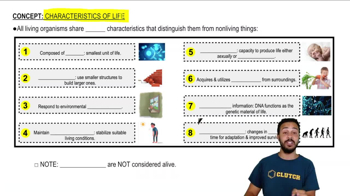
Order, Regulation, Growth and Development, Energy Processing, Response to Environment, Reproduction, and Evolutionary Adaptation.
Biological order refers to the highly organized structure of living organisms, from molecules to cells to organisms.
Regulation is the ability of organisms to maintain internal stability despite external changes (homeostasis).
Growth and development involve the increase in size and the progression through life stages controlled by genetic information.
Energy processing is the use of energy by organisms to perform life activities like metabolism.
Response to environment is the ability to detect and react to stimuli for survival.
Reproduction is the process by which organisms produce offspring to continue their species.
Evolutionary adaptation is the process by which populations change over generations to better survive in their environment.
Molecule, Organelle, Cell, Tissue, Organ, Organ System, Organism, Population, Community, Ecosystem, Biosphere.
A molecule is a chemical structure consisting of atoms bonded together, essential for life.
An organelle is a specialized structure within a cell that performs a specific function.
The cell is the basic structural and functional unit of all living organisms.
Tissues are groups of similar cells that work together to perform a specific function.
An organ is a structure composed of different tissues working together to perform a particular task.
An organ system is a group of organs that collaborate to carry out major body functions.
An organism is an individual living entity capable of independent life.
A population is a group of organisms of the same species living in a specific area.
A community consists of all populations of different species living and interacting in an area.
An ecosystem includes all living organisms in an area plus the physical environment with which they interact.
The biosphere is the global sum of all ecosystems, encompassing all life on Earth and their environments.