Indietro

Protein Structure and Function in General Biology

I pulsanti di controllo sono stati cambiati in modalità "navigazione".
1/23
  • Functions of proteins

    • Structural support
    • Storage
    • Transport
    • Cellular communication
    • Movement
    • Defense against foreign substances
  • Role of enzymatic proteins

    Proteins act as catalysts in cells, selectively accelerating chemical reactions without being consumed.
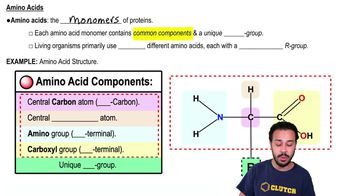
  • Basic structure of amino acids

    Each amino acid has a central alpha carbon bonded to an amino group, carboxyl group, hydrogen atom, and a variable R group.
  • Role of the R group in amino acids

    The R group determines the unique chemical properties of each amino acid, including polarity and charge.
  • Classification of amino acids by R group polarity

    Nonpolar R groups are hydrophobic; polar R groups are hydrophilic; some R groups are charged (acidic or basic).
  • Acidic vs Basic amino acids

    Acidic amino acids have negatively charged R groups due to carboxyl groups; basic amino acids have positively charged R groups due to amino groups.
  • Formation of peptide bonds

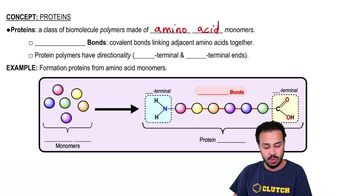
    A dehydration reaction links amino acids by removing –OH from one carboxyl and –H from another amino group, forming a covalent peptide bond.
  • Polypeptide chain directionality

    Polypeptides have an N-terminus with a free amino group and a C-terminus with a free carboxyl group.
  • Primary structure of proteins

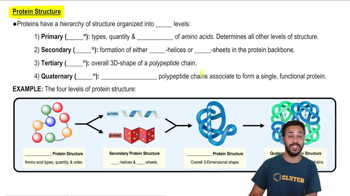
    The unique sequence of amino acids in a polypeptide chain.
  • Secondary structure of proteins

    Coils and folds stabilized by hydrogen bonds between the polypeptide backbone, including α helices and β pleated sheets.
  • Characteristics of α helix

    A delicate coil held by hydrogen bonds every fourth amino acid, common in fibrous proteins like α-keratin.
  • Characteristics of β pleated sheet

    Formed by parallel polypeptide chains linked by hydrogen bonds, providing strength as in spider silk.
  • Tertiary structure of proteins

    The overall 3D shape of a single polypeptide, stabilized by interactions among R groups.
  • Types of interactions stabilizing tertiary structure

    • Hydrogen bonds
    • Ionic bonds
    • Hydrophobic interactions
    • van der Waals interactions
    • Disulfide bridges (covalent bonds between cysteines)
  • Disulfide bridges

    Strong covalent bonds between sulfhydryl groups of two cysteine amino acids that lock protein parts in place.
  • Quaternary structure of proteins

    The aggregation of two or more polypeptide subunits into a functional protein complex.
  • Examples of proteins with quaternary structure

    Hemoglobin (four subunits), transthyretin (four identical polypeptides), and collagen (three supercoiled polypeptides).
  • Storage proteins example

    Casein in milk stores amino acids for baby mammals; ovalbumin in egg white serves as an amino acid source for embryos.
  • Transport proteins example

    Hemoglobin transports oxygen from lungs to body tissues across membranes.
  • Defensive proteins example

    Antibodies inactivate and help destroy viruses and bacteria to protect against disease.
  • Hormonal proteins example

    Insulin regulates blood sugar by signaling tissues to take up glucose.
  • Contractile and motor proteins

    Proteins like actin and myosin are responsible for muscle contraction and movement of cilia and flagella.
  • Structural proteins example

    Keratin forms hair, horns, and feathers; collagen and elastin provide fibrous frameworks in connective tissues.